

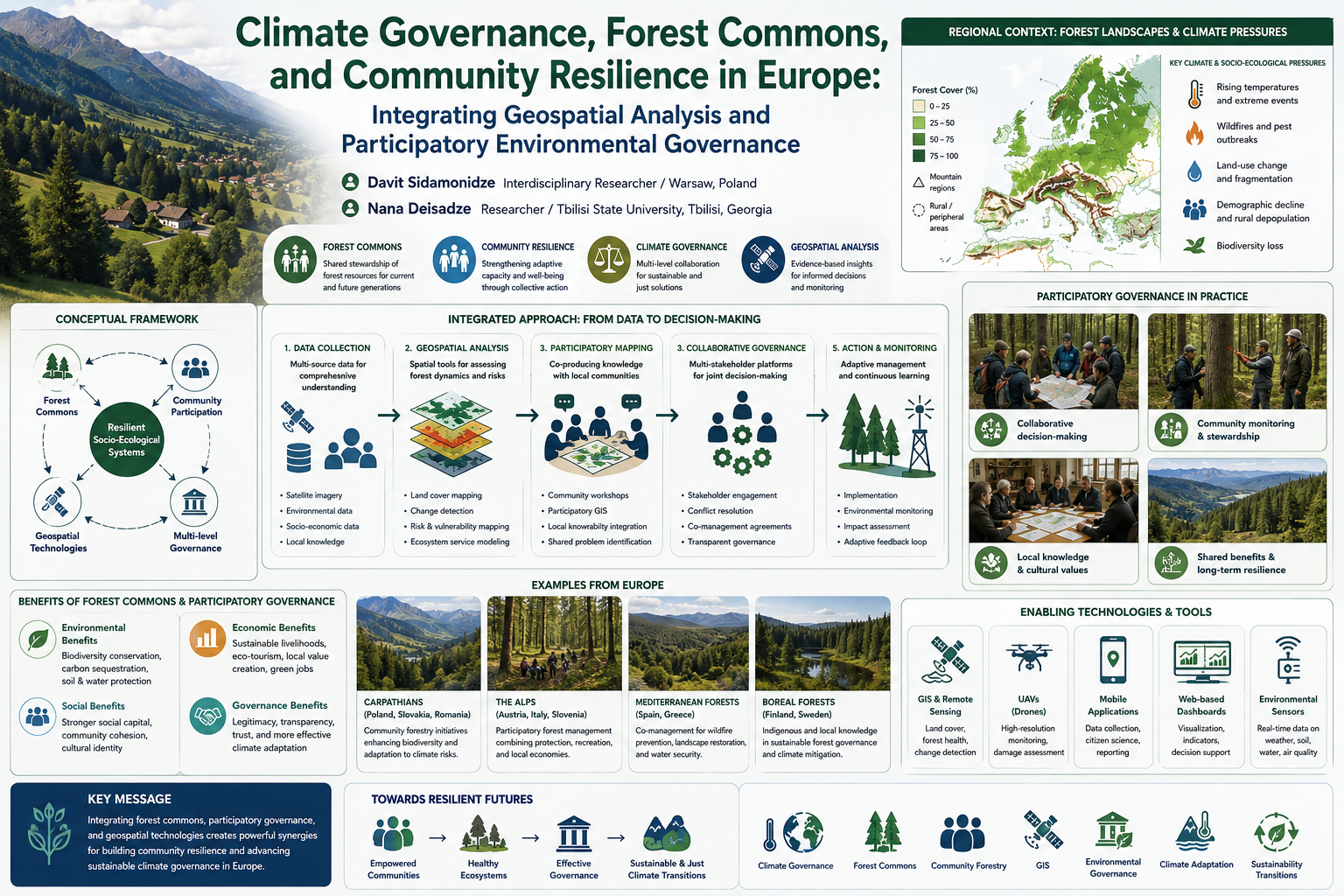
Climate Governance, Forest Commons, and Community Resilience in Europe: Integrating Geospatial Analysis and Participatory Environmental Governance
Climate Governance, Forest Commons, and Community Resilience in Europe: Integrating Geospatial Analysis and Participatory Environmental Governance
Davit Sidamonidze Interdisciplinary Researcher / Warsaw, Poland
Nana Deisadze Researcher / Tbilisi State University, Tbilisi, Georgia
Abstract
Climate change is reshaping environmental governance systems across Europe, particularly in forest-dependent and mountain regions where socio-ecological systems face increasing pressures from biodiversity loss, land-use change, demographic decline, and climate-related hazards. At the same time, local communities are developing innovative governance arrangements to strengthen resilience and promote sustainable resource management. This paper examines the role of forest commons and participatory environmental governance in enhancing climate resilience across European regions. Drawing upon theories of socio-ecological systems, environmental governance, and common-pool resource management, the study explores how community-based forest governance contributes to adaptive capacity and sustainable development. Particular attention is given to the integration of geospatial technologies, participatory mapping, and environmental monitoring systems that support evidence-based decision-making. The article argues that combining local ecological knowledge with advanced spatial analysis creates opportunities for more effective climate adaptation strategies. The paper concludes by proposing a research agenda that connects environmental governance, digital technologies, and community resilience, offering important implications for policymakers, researchers, and practitioners working in the context of sustainability transitions and climate governance.
Keywords: Climate Governance; Forest Commons; Community Forestry; GIS; Environmental Governance; Climate Adaptation; Sustainability Transitions
Introduction
Climate change represents one of the most significant challenges facing contemporary societies. Increasing temperatures, extreme weather events, biodiversity decline, and ecosystem degradation require new approaches to environmental governance that are capable of addressing complex socio-ecological interactions (IPCC, 2023). Traditional top-down governance models often struggle to respond effectively to local environmental challenges, leading researchers and policymakers to explore alternative governance arrangements that involve communities directly in decision-making processes.
Community-based natural resource management and commons governance have gained renewed attention in sustainability science. Forest commons, in particular, provide important examples of collective action that contribute to biodiversity conservation, ecosystem services, and rural livelihoods (Ostrom, 1990). Across Europe, historical and contemporary forms of communal forest management demonstrate how local institutions can adapt to changing environmental conditions while maintaining sustainable resource use.
At the same time, advances in geographic information systems (GIS), remote sensing, and spatial data science offer unprecedented opportunities for monitoring environmental change and supporting governance decisions. Integrating these technologies with participatory governance approaches can strengthen adaptive capacity and improve climate resilience.
This paper explores the intersection of climate governance, forest commons, and geospatial technologies. It seeks to answer the following questions:
- How do community-based forest governance systems contribute to climate resilience?
- What role can geospatial technologies play in supporting participatory environmental governance?
- How can environmental governance frameworks be adapted to address future climate challenges?
Literature Review
Environmental Governance and Climate Adaptation
Environmental governance refers to the institutions, policies, and processes through which environmental decisions are made and implemented (Lemos & Agrawal, 2006). Contemporary governance approaches increasingly emphasize participation, collaboration, and multi-level governance arrangements.
Climate adaptation requires governance systems capable of responding to uncertainty and change. Adaptive governance frameworks stress flexibility, learning, and stakeholder participation as essential components of resilience (Folke et al., 2005). Community engagement is particularly important because local populations often possess valuable knowledge regarding environmental conditions and resource management practices.
Commons and Collective Action
The governance of common-pool resources has been extensively studied since the publication of Ostrom’s seminal work Governing the Commons (1990). Contrary to assumptions that commons inevitably lead to resource degradation, research demonstrates that communities can develop effective institutions for sustainable resource management.
Forest commons remain important in many European countries. These systems often combine traditional governance arrangements with contemporary environmental regulations. Studies suggest that successful commons governance depends on clearly defined boundaries, collective decision-making processes, monitoring mechanisms, and conflict-resolution procedures (Agrawal, 2001).
Geospatial Technologies and Environmental Monitoring
Technological advances have transformed environmental research and management. Remote sensing data, GIS platforms, and spatial modeling techniques allow researchers to analyze environmental changes at multiple scales.
Applications include:
- Forest cover monitoring
- Biodiversity assessment
- Land-use change analysis
- Natural hazard mapping
- Climate vulnerability assessment
Participatory GIS approaches further enable communities to contribute local knowledge to environmental decision-making processes (Brown & Kyttä, 2014). These approaches support democratic governance while enhancing the quality of environmental information.
Methodological Framework
This study adopts an interdisciplinary framework combining environmental governance theory, socio-ecological systems analysis, and spatial methodologies.
The proposed research design includes three components:
- Comparative Case Studies
Case studies from selected European regions will be examined, including:
- Community forests in Georgia
- Alpine commons in Switzerland
- Forest cooperatives in Germany
These cases provide opportunities to compare governance structures, adaptation strategies, and institutional arrangements.
- Geospatial Analysis
Spatial datasets will be analyzed using GIS and remote sensing techniques.
Potential data sources include:
- Copernicus Land Monitoring Service
- Sentinel satellite imagery
- National forest inventories
- Climate datasets from the European Environment Agency
Indicators include:
- Forest cover change
- Fragmentation patterns
- Vegetation health indices
- Climate exposure measures
- Stakeholder Perspectives
Semi-structured interviews and participatory workshops will be conducted with:
- Community forest managers
- Environmental NGOs
- Local government representatives
- Researchers
This qualitative component will explore perceptions of environmental change and governance effectiveness.
Discussion
Forest Commons as Climate Adaptation Mechanisms
Forest commons contribute to climate adaptation in several ways. First, collective management arrangements often facilitate coordinated responses to environmental risks. Communities can collectively invest in ecosystem restoration, fire prevention, and biodiversity conservation measures.
Second, local governance systems often incorporate traditional ecological knowledge accumulated over generations. Such knowledge can complement scientific monitoring and improve adaptation planning.
Third, commons institutions frequently strengthen social capital and community cohesion. These social resources are critical for responding to environmental disturbances and maintaining adaptive capacity.
Digital Technologies and Participatory Governance
The integration of geospatial technologies into environmental governance presents significant opportunities. Satellite monitoring and GIS platforms enable stakeholders to visualize environmental changes, identify risks, and evaluate management outcomes.
However, technological tools should not replace local participation. Instead, they should support collaborative decision-making processes by providing accessible and transparent information.
Participatory mapping initiatives demonstrate how digital technologies can empower communities and enhance governance legitimacy. By combining scientific and local knowledge systems, stakeholders can develop more robust adaptation strategies.
Implications for Sustainability Transitions
Climate adaptation requires broader transformations in governance systems. The concept of sustainability transitions emphasizes systemic changes involving institutions, technologies, and social practices (Geels, 2002).
Forest commons illustrate how local governance innovations can contribute to wider sustainability transitions. These systems provide practical examples of collaborative governance, resource stewardship, and resilience-building that may inform policy development across Europe.
Conclusion
The challenges posed by climate change require innovative governance approaches that integrate scientific knowledge, digital technologies, and community participation. Forest commons provide valuable examples of collective action that enhance environmental resilience and support sustainable resource management.
Geospatial technologies offer powerful tools for environmental monitoring and decision support, but their effectiveness depends on meaningful stakeholder engagement. Combining participatory governance with advanced spatial analysis can strengthen climate adaptation efforts and contribute to more sustainable socio-ecological systems.
Future research should further explore the interactions between environmental governance, technological innovation, and community resilience across diverse geographical contexts. Such work can support evidence-based policymaking and contribute to the development of more adaptive and equitable environmental governance systems.
References
Agrawal, A. (2001). Common property institutions and sustainable governance of resources. World Development, 29(10), 1649–1672.
Brown, G., & Kyttä, M. (2014). Key issues and research priorities for public participation GIS. Landscape and Urban Planning, 122, 1–11.
Folke, C., Hahn, T., Olsson, P., & Norberg, J. (2005). Adaptive governance of social-ecological systems. Annual Review of Environment and Resources, 30, 441–473.
Geels, F. W. (2002). Technological transitions as evolutionary reconfiguration processes. Research Policy, 31(8–9), 1257–1274.
IPCC. (2023). Climate Change 2023: Synthesis Report. Intergovernmental Panel on Climate Change.
Lemos, M. C., & Agrawal, A. (2006). Environmental governance. Annual Review of Environment and Resources, 31, 297–325.
Ostrom, E. (1990). Governing the Commons: The Evolution of Institutions for Collective Action. Cambridge University Press.