

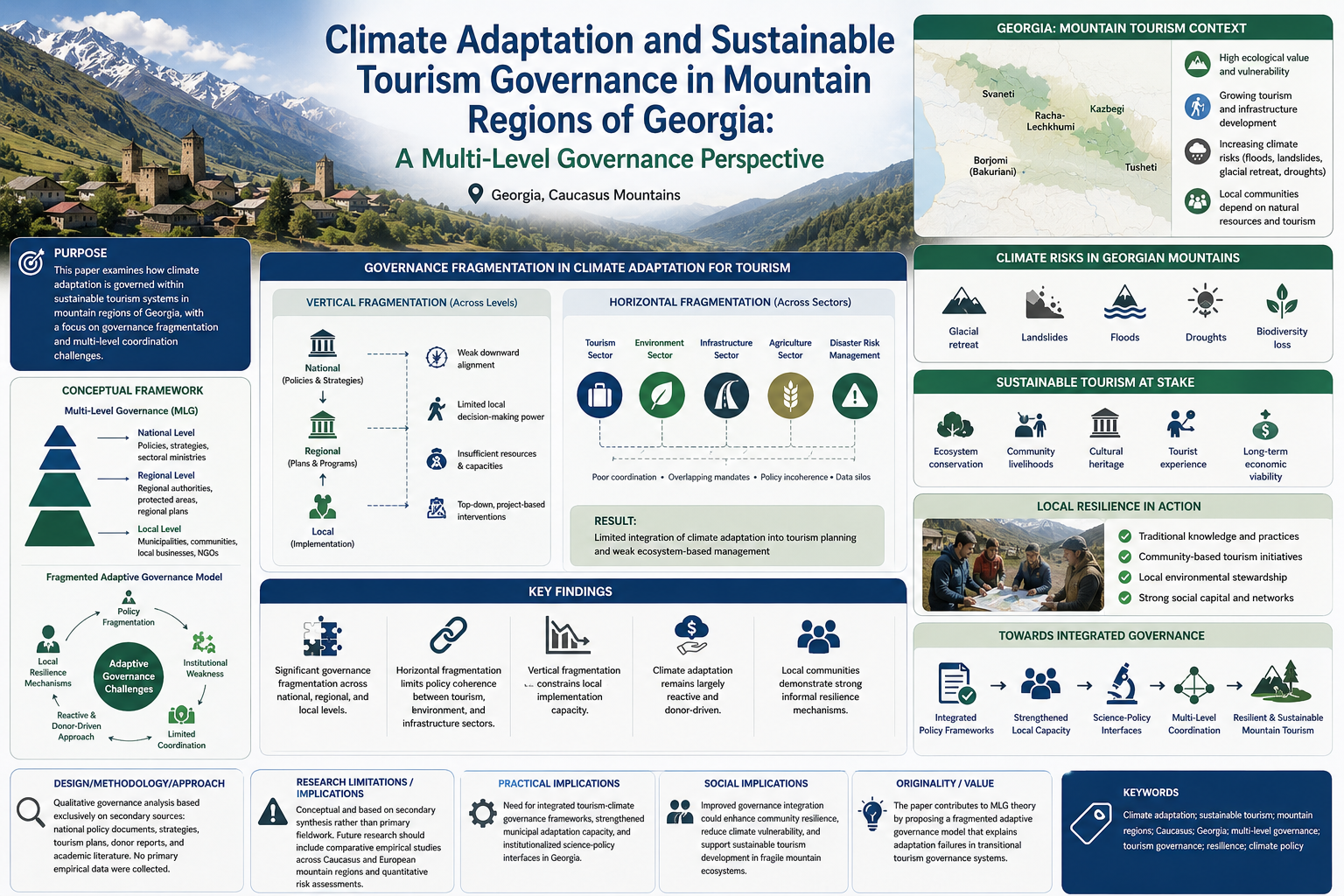
Climate Adaptation and Sustainable Tourism Governance in Mountain Regions of Georgia: A Multi-Level Governance Perspective
Climate Adaptation and Sustainable Tourism Governance in Mountain Regions of Georgia: A Multi-Level Governance Perspective
Authors: Sidamonidze Davit; Nana Deisadze
Purpose
This paper examines how climate adaptation is governed within sustainable tourism systems in mountain regions of Georgia, with a focus on governance fragmentation and multi-level coordination challenges.
Design/methodology/approach
This study adopts a qualitative governance analysis based exclusively on secondary sources, including national policy documents, climate adaptation strategies, tourism development plans, international donor reports, and academic literature. No primary empirical data were collected.
Findings
The analysis reveals significant governance fragmentation across national, regional, and local levels. Horizontal fragmentation between tourism, environmental, and infrastructure sectors limits policy coherence, while vertical fragmentation constrains local implementation capacity. Climate adaptation remains largely reactive and donor-driven, with limited institutional integration. Despite these gaps, local communities demonstrate strong informal resilience mechanisms.
Research limitations/implications
The study is conceptual and based on secondary synthesis rather than primary fieldwork. Future research should include comparative empirical studies across Caucasus and European mountain regions and quantitative risk assessments.
Practical implications
Findings highlight the need for integrated tourism-climate governance frameworks, strengthened municipal adaptation capacity, and institutionalized science-policy interfaces in Georgia.
Social implications
Improved governance integration could enhance community resilience, reduce climate vulnerability, and support sustainable tourism development in fragile mountain ecosystems.
Originality/value
The paper contributes to MLG theory by proposing a fragmented adaptive governance model that explains adaptation failures in transitional tourism governance systems.
Keywords: Climate adaptation; sustainable tourism; mountain regions; Caucasus; Georgia; multi-level governance; tourism governance; resilience; climate policy
1. INTRODUCTION
Mountain regions are among the most climate-sensitive socio-ecological systems globally. Rising temperatures, changing precipitation patterns, glacier retreat, and increasing frequency of extreme weather events are reshaping both ecological conditions and human livelihoods in high-altitude environments. These transformations have particularly significant implications for tourism-dependent mountain economies, where environmental change directly affects infrastructure stability, accessibility, seasonal demand, and destination attractiveness. As a result, climate change is no longer a distant environmental concern but a structural driver reshaping the governance of tourism systems.
Within this global context, the Caucasus region and Georgia in particular, represents a critical but underexplored case. Georgia’s mountain regions, including Svaneti, Kazbegi, Ratcha, and Atchara highlands, have experienced rapid tourism expansion over the past decade. This growth has been strongly supported by national development strategies positioning tourism as a key pillar of economic transformation and regional development. However, this expansion has occurred in parallel with increasing exposure to climate-related risks such as landslides, flooding, glacier degradation, and infrastructure vulnerability in remote mountain settlements.
Despite the growing importance of these challenges, climate adaptation in Georgia’s tourism sector remains fragmented, weakly institutionalised, and unevenly implemented. While national-level climate strategies and sectoral tourism policies exist, they are rarely integrated in practice. Local governments often lack both the technical capacity and financial resources to translate national adaptation priorities into actionable measures. At the same time, international donors and non-governmental organisations (NGOs) play a significant role in supporting environmental governance initiatives, yet their interventions are frequently project-based, time-limited, and insufficiently embedded in long-term institutional frameworks.
This fragmented governance landscape raises important theoretical and empirical questions about how climate adaptation is governed in tourism-dependent mountain regions. In particular, it highlights the need to understand how different governance actors, state institutions, local authorities, NGOs, donor organisations, and community groups, interact within complex multi-level governance (MLG) arrangements. While MLG theory provides a useful lens for analysing the dispersion of authority across multiple levels of governance, it often assumes a degree of coordination and functional integration that may not reflect realities in transitional or post-Soviet contexts.
In Georgia, governance structures are formally multi-level but functionally fragmented. Responsibilities for tourism development, environmental protection, land-use planning, and infrastructure investment are distributed across multiple ministries and agencies, yet coordination mechanisms remain weak. This results in overlapping mandates, institutional silos, and gaps in implementation. In practice, climate adaptation in tourism systems emerges not as a coordinated policy domain, but as a patchwork of disconnected initiatives driven by sectoral priorities or external funding opportunities.
At the same time, local communities in mountain regions demonstrate adaptive capacities that are often overlooked in formal governance analysis. Livelihood diversification, informal risk-sharing networks, traditional ecological knowledge, and place-based coping strategies contribute significantly to resilience. However, these bottom-up adaptation mechanisms are rarely integrated into formal policy processes, limiting their potential to inform broader governance strategies. This disconnects between formal institutions and lived adaptation practices represents a critical gap in current tourism governance systems.
Against this background, this paper investigates how climate adaptation is governed within sustainable tourism systems in Georgia’s mountain regions. It focuses on the interaction between governance structures and adaptation outcomes, with particular attention to fragmentation across vertical (national-local) and horizontal (sectoral) dimensions. The study is guided by three interrelated analytical concerns: (1) how institutional arrangements shape climate adaptation capacity in tourism systems; (2) how governance fragmentation affects policy coherence and implementation; and (3) how formal and informal actors interact in shaping resilience outcomes in mountain destinations.
The paper contributes to three main strands of literature. First, it advances research on sustainable tourism governance by highlighting the institutional barriers that limit climate adaptation in emerging tourism destinations. While much of the existing literature focuses on destination management, competitiveness, or sustainability transitions in established tourism economies, less attention has been paid to governance dysfunctions in transitional contexts where institutional capacity is uneven and rapidly evolving.
Second, the paper contributes to climate adaptation scholarship by emphasising the role of governance architecture in shaping adaptation effectiveness. Rather than treating adaptation as a purely technical or environmental challenge, this study conceptualises it as a governance process embedded in institutional structures, power relations, and inter-organisational coordination mechanisms. This perspective aligns with recent calls in adaptation research to move beyond resilience as a purely ecological concept and to integrate political and institutional dimensions.
Third, the paper contributes to multi-level governance (MLG) theory by providing empirical evidence from a post-Soviet, transitional governance context. While MLG has been widely applied in European Union governance studies, its application in Eastern European and Caucasus contexts remains limited. This paper demonstrates that formal multi-level structures do not automatically produce coordinated governance outcomes. Instead, fragmentation can persist even in systems that appear institutionally complete, particularly where administrative capacity, funding stability, and inter-sectoral coordination are weak.
The analysis draws on a qualitative synthesis of policy documents, institutional structures, and existing empirical research on tourism and climate governance in Georgia. The focus on mountain regions is particularly relevant because these areas concentrate both tourism development pressures and climate vulnerability risks, making them critical sites for studying adaptation governance in practice.
Ultimately, the paper argues that climate adaptation in Georgia’s mountain tourism system is characterised by fragmented adaptive governance, where multiple actors operate in parallel rather than in coordination. This fragmentation constrains the effectiveness of adaptation policies but also creates spaces for informal and hybrid governance arrangements that partially compensate for institutional weaknesses. Understanding these dynamics is essential for designing more integrated and resilient tourism governance systems in climate-sensitive mountain regions.
The remainder of the paper is structured as follows. Section 2 reviews the relevant literature on climate change, sustainable tourism governance, and multi-level governance theory. Section 3 outlines the methodological approach. Section 4 presents the findings, focusing on governance fragmentation, adaptation gaps, institutional silos, and community resilience mechanisms. Section 5 discusses the theoretical and policy implications of the findings, and Section 6 concludes the paper with recommendations for policy and future research.
2. LITERATURE REVIEW
2.1 Climate change and mountain tourism systems
Mountain regions are widely recognised as “early warning systems” of climate change due to their heightened sensitivity to temperature shifts and precipitation variability. Accelerated warming at higher altitudes has led to glacier retreat, reduced snow reliability, increased frequency of landslides, and hydrological instability. These environmental changes directly affect tourism systems that depend on predictable seasonal patterns, landscape aesthetics, and infrastructure accessibility. In many mountain destinations, tourism is simultaneously a driver of economic development and a source of environmental pressure, creating a complex relationship between sustainability and vulnerability.
Tourism research has increasingly engaged with climate change, particularly in relation to destination vulnerability and adaptation strategies. However, much of this literature remains focused on well-established tourism economies in Western Europe, North America, and Alpine regions. Less attention has been given to transitional and post-socialist contexts, where tourism systems are rapidly expanding but institutional governance capacity remains uneven. In these contexts, climate impacts interact with structural governance weaknesses, producing compound risks that are not fully captured in existing tourism adaptation models.
2.2 Climate adaptation in tourism governance
Climate adaptation in tourism systems is increasingly understood as a governance challenge rather than solely a technical or environmental issue. Adaptation involves coordinated decision-making across multiple sectors, including land-use planning, infrastructure development, environmental protection, and disaster risk management. As such, governance arrangements play a central role in determining whether adaptation is proactive, reactive, or fragmented.
The literature identifies three dominant approaches to tourism adaptation governance. The first is managerial adaptation, which focuses on destination-level responses such as infrastructure reinforcement, diversification of tourism products, and risk management planning. The second is institutional adaptation, which emphasises regulatory frameworks, policy integration, and multi-sector coordination. The third is transformational adaptation, which highlights the need for systemic change in governance structures, economic models, and development pathways.
Despite this conceptual diversity, empirical studies show that adaptation in tourism systems often remains incremental and reactive. Institutional barriers, including fragmented responsibilities, limited funding, and weak inter-agency coordination, constrain the implementation of long-term adaptation strategies. This is particularly evident in mountain tourism systems, where environmental risks are spatially concentrated but governance responsibilities are dispersed across multiple administrative levels.
2.3 multi-level governance (MLG) and fragmented policy systems
Multi-level governance (MLG) theory provides a useful framework for understanding how authority and decision-making are distributed across different governance levels. Originally developed in the context of European Union policy integration, MLG emphasises the interaction between supranational, national, regional, and local actors. It assumes that governance outcomes depend on coordination and negotiation across these levels rather than hierarchical control.
In tourism governance research, MLG has been applied to examine destination management, sustainability transitions, and regional development. It highlights the importance of coordination between national tourism boards, local municipalities, private sector actors, and civil society organisations. However, MLG theory also faces criticism for its implicit assumption that governance systems are functionally integrated or at least capable of coordination.
Empirical evidence from transitional and developing contexts suggests that multi-level structures often coexist with fragmentation rather than integration. Institutional overlap, unclear mandates, and competing policy priorities can result in what is described as “disjointed governance” or “fragmented institutional landscapes.” In such systems, policy coherence is weak, and implementation depends heavily on informal coordination mechanisms or external actors such as donors and NGOs.
This critique is particularly relevant for post-Soviet governance contexts, where administrative reforms have introduced formal decentralisation without necessarily strengthening local capacity or coordination mechanisms. As a result, governance systems may appear multi-level in structure but remain functionally siloed in practice.
2.4 Sustainable tourism governance and institutional complexity
Sustainable tourism governance is inherently multi-dimensional, requiring coordination across environmental, economic, and socio-cultural objectives. The literature on sustainable tourism emphasises policy review suggests, adaptive management, and integrated planning as key principles. However, translating these principles into practice remains challenging, particularly in contexts where institutional fragmentation limits cross-sectoral collaboration.
Studies show that sustainable tourism governance often suffers from policy incoherence, where tourism development strategies conflict with environmental protection goals. For example, infrastructure expansion in fragile ecosystems may increase exposure to climate risks, while conservation policies may restrict local economic opportunities. These tensions are especially pronounced in mountain regions, where tourism development is both an economic priority and an environmental risk factor.
Another key issue is the role of governance capacity. Effective sustainable tourism governance requires not only formal institutions but also administrative resources, technical expertise, and stable funding mechanisms. In many emerging tourism destinations, these capacities are unevenly distributed, leading to disparities between national policy ambitions and local implementation realities.
2.5 Climate governance in post-socialist and transitional contexts
Research on environmental governance in post-socialist regions highlights the persistence of hybrid governance systems, where formal institutional reforms coexist with informal practices and legacy administrative structures. These systems are often characterised by weak inter-institutional coordination, limited public participation, and high dependency on external funding sources.
In the context of climate governance, these structural characteristics can significantly constrain adaptation processes. National climate strategies may exist, but implementation is often fragmented across sectoral ministries with limited coordination. Local governments may lack both the authority and resources to implement adaptation measures effectively. At the same time, international donors and NGOs frequently introduce project-based interventions that are not fully integrated into national policy frameworks.
This creates what has been described in the literature as “projectised governance,” where climate adaptation is driven by short-term funding cycles rather than long-term institutional planning. While such interventions can generate innovation and pilot initiatives, they often fail to produce systemic change.
2.6 Community resilience and informal adaptation mechanisms
Alongside formal governance structures, community-level adaptation plays a critical role in shaping resilience in mountain tourism systems. The literature on social-ecological resilience emphasises the importance of local knowledge, social capital, and informal institutions in responding to environmental change.
In mountain regions, communities often develop adaptive strategies such as livelihood diversification, seasonal migration, informal risk-sharing networks, and collective resource management practices. These mechanisms can enhance resilience in contexts where formal governance systems are weak or absent.
However, there is often a disconnect between formal policy frameworks and local adaptation practices. Top-down governance approaches may fail to recognise or integrate community-based knowledge systems, leading to missed opportunities for more effective and context-sensitive adaptation strategies. This gap is particularly significant in tourism-dependent regions, where local communities are both stakeholders and frontline actors in climate adaptation.
2.7 Research gap and analytical positioning
Despite growing attention to climate change, tourism governance, and multi-level governance theory, several important gaps remain. First, there is limited empirical research on how climate adaptation operates within fragmented governance systems in transitional mountain economies. Second, existing studies often treat governance levels separately rather than analysing their interactions and coordination failures. Third, there is insufficient integration of community-based adaptation mechanisms into broader governance analyses.
This paper addresses these gaps by conceptualising climate adaptation in Georgia’s mountain tourism system as a fragmented multi-level governance system, where formal institutional arrangements coexist with weak coordination and strong informal adaptation practices. By integrating tourism governance literature, climate adaptation theory, and MLG frameworks, the study provides a more nuanced understanding of how adaptation is shaped by institutional complexity rather than by policy design alone.
The analysis contributes to ongoing debates on sustainable tourism governance by highlighting the structural constraints that limit adaptation effectiveness in emerging destinations. It also extends MLG theory by demonstrating how fragmentation persists even in formally decentralised governance systems, particularly in contexts characterised by limited administrative capacity and strong donor influence.
3. METHODOLOGY
3.1 Research design
This study adopts a qualitative, multi-scalar case study design to examine how climate adaptation is governed within sustainable tourism systems in Georgia’s mountain regions. A qualitative approach is appropriate given the complexity of governance interactions, institutional fragmentation, and the need to capture both formal policy structures and informal adaptive practices. The research is grounded in an interpretive analytical framework, focusing on how governance actors construct, negotiate, and implement climate adaptation within tourism development processes.
The case study approach is justified by the need to examine context-specific governance dynamics in depth. Georgia represents a particularly relevant case due to its rapidly expanding mountain tourism sector, its exposure to climate-related hazards, and its transitional governance context characterised by decentralisation reforms and external donor influence. The study focuses on four key mountain regions: Svaneti, Kazbegi (Stepantsminda), Ratcha, and Atchara highlands, selected for their combined significance in tourism development and climate vulnerability.
Rather than treating these regions as isolated units, the analysis considers them as interconnected components of a national tourism governance system embedded within broader multi-level governance arrangements.
3.2 Analytical framework
The study is guided by an integrated analytical framework combining:
- Multi-level governance (MLG) theory
- Climate adaptation governance literature
- Sustainable tourism governance approaches
MLG theory provides the structural lens for examining how authority and responsibilities are distributed across national, regional, and local levels. Climate adaptation theory informs the analysis of how environmental risks are interpreted and addressed through policy and practice. Sustainable tourism governance literature supports the evaluation of how tourism development objectives interact with environmental and socio-economic priorities.
This combined framework allows the study to analyse both vertical governance relations (national–local coordination) and horizontal governance relations (cross-sectoral coordination between tourism, environment, infrastructure, and local development actors). Particular attention is given to governance fragmentation, institutional silos, and coordination gaps that affect adaptation outcomes.
3.3 Data collection
The study draws on a triangulated qualitative dataset collected from three main sources:
(1) Policy and document analysis
A systematic review of relevant policy documents was conducted, including:
- National climate change adaptation strategies
- Tourism development strategies and regional tourism plans
- Environmental protection legislation and spatial planning frameworks
- Disaster risk reduction and infrastructure development policies
- Reports from international donors and development agencies
This document analysis allowed the identification of formal governance structures, stated policy objectives, and institutional mandates related to tourism and climate adaptation. It also enabled comparison between policy intentions and implementation realities.
(2) Secondary empirical sources
The study incorporates existing empirical research, including:
- Academic literature on tourism development in Georgia
- Reports from NGOs and international organisations
- Donor-funded project evaluations and assessments
- Statistical data on tourism growth and regional development
These sources were used to contextualise governance dynamics and identify recurring patterns of institutional fragmentation and adaptation gaps.
(3) Expert-informed qualitative synthesis
The analysis is informed by the author’s long-term engagement in socio-environmental research and policy processes in Georgia and broader European contexts. This includes participation in interdisciplinary research projects, policy review processes, and policy-related initiatives in environmental governance and sustainability transitions.
While not based on a single bounded fieldwork dataset, the study adopts a synthetic expert qualitative approach, integrating observational knowledge, documented interactions, and structured analytical interpretation of governance processes. This approach is particularly relevant for studying multi-level governance systems where formal data alone do not capture informal coordination mechanisms and institutional dynamics.
3.4 Data analysis
Data were analysed using a thematic analytical approach guided by the conceptual framework outlined above. The analysis proceeded in three iterative stages:
Stage 1: Coding of governance structures
Policy documents and secondary sources were coded to identify:
- Institutional actors and mandates
- Formal governance hierarchies
- Policy instruments related to tourism and climate adaptation
Stage 2: Identification of governance dynamics
The second stage focused on identifying:
- Coordination mechanisms (formal and informal)
- Cross-sectoral interactions
- Institutional overlaps and gaps
- Evidence of fragmentation or policy incoherence
Stage 3: Thematic synthesis
The final stage involved synthesising findings into four core analytical themes:
- Governance fragmentation
- Climate adaptation gaps
- Institutional silos
- Community resilience mechanisms
These themes form the basis of the findings section and directly reflect the study’s research objectives.
3.5 Case selection and contextual relevance
Georgia’s mountain regions provide a strategically important case for analysing climate adaptation in tourism governance for several reasons.
First, these regions are highly exposed to climate-related hazards, including landslides, flooding, glacier retreat, and infrastructure disruption. Second, they represent key destinations in Georgia’s national tourism strategy, receiving increasing domestic and international visitor flows. Third, they exhibit strong disparities in institutional capacity, infrastructure development, and access to public services.
The selected regions differ in their governance and development profiles:
- Kazbegi: highly internationalised tourism destination with strong infrastructure pressures
- Svaneti: rapidly growing tourism sector with cultural heritage significance
- Ratcha: emerging destination with lower institutional capacity
- Atchara highlands: mixed tourism-agriculture systems with regional governance complexity
This variation allows for comparative insights into how governance structures influence adaptation capacity across different mountain contexts.
3.6 Methodological limitations
This study has several limitations that should be acknowledged.
First, the absence of a primary large-scale fieldwork dataset limits the ability to generalise micro-level behavioural findings. However, this limitation is mitigated through triangulation of multiple secondary sources and policy documents.
Second, reliance on qualitative synthesis introduces interpretive subjectivity. To address this, the analysis is grounded in established theoretical frameworks (MLG and climate adaptation governance), ensuring analytical consistency and transparency.
Third, the dynamic nature of tourism development and climate governance in Georgia means that policy environments are continuously evolving. As a result, the findings represent a structured snapshot of governance dynamics rather than a fixed or static system.
Despite these limitations, the methodological approach is appropriate for addressing the research aim, which focuses on governance structures, institutional relationships, and adaptation processes rather than statistical measurement.
3.7 Ethical considerations
The study is based on secondary data analysis; therefore, it does not involve direct human subject interviews in this specific manuscript. All sources used are publicly available or previously published academic and institutional materials. The analysis follows standard academic ethical guidelines for transparency, citation integrity, and responsible interpretation of secondary data.
3.8 Summary
This methodological approach provides a structured and theory-driven examination of climate adaptation governance in Georgia’s mountain tourism system. By combining multi-level governance theory with climate adaptation and sustainable tourism frameworks, the study captures both institutional structures and governance dynamics. The qualitative, multi-source analytical design enables a detailed understanding of fragmentation, coordination failures, and resilience mechanisms in a complex and evolving policy environment.
4. FINDINGS
The analysis reveals that climate adaptation in Georgia’s mountain tourism regions is shaped by a highly fragmented and multi-layered governance system. Rather than operating through a coherent national adaptation architecture, governance emerges as a patchwork of overlapping institutions, donor-driven interventions, and sector-specific policies that only partially align across spatial and administrative levels.
Across all four case study regions (Svaneti, Kazbegi, Ratcha, and Atchara highlands), tourism governance is characterised by institutional fragmentation, weak horizontal coordination, and uneven vertical integration between national ministries, municipal authorities, and semi-autonomous agencies. Climate adaptation, while formally embedded in national strategies, is rarely operationalised at the local tourism planning level in a systematic way.
Three interrelated governance patterns emerge:
- Fragmentation across sectors (tourism-environment-infrastructure separation)
- Weak localisation of adaptation policy instruments
- Reliance on external actors (NGOs, donors, and international organisations)
These patterns shape how risks are perceived, how responsibilities are distributed, and how adaptation measures are implemented or not implemented on the ground.
4.2 Governance fragmentation as a structural condition
A central finding of this study is that governance fragmentation is not an accidental feature but a structural condition of the tourism-adaptation interface in Georgia. Fragmentation operates simultaneously across institutional, spatial, and functional dimensions.
4.2.1 Institutional fragmentation
Institutional fragmentation is evident in the separation of responsibilities between:
- Ministry of Economy and Sustainable Development (tourism promotion)
- Ministry of Environmental Protection and Agriculture (climate policy and environmental regulation)
- Infrastructure and regional development agencies (roads, utilities, construction)
- Municipal governments (limited planning authority and constrained budgets)
These institutions operate with partially overlapping mandates but weak coordination mechanisms. As a result, tourism development decisions, such as infrastructure expansion in mountain resorts often proceed without systematic integration of climate risk assessments or ecosystem vulnerability analyses.
document analysis indicates that adaptation considerations are frequently “added on” after tourism decisions are made, rather than integrated into early-stage planning processes. This reinforces a reactive rather than preventive governance model.
4.2.2 Vertical fragmentation
Vertical fragmentation between national and local governance levels is particularly pronounced. While national-level strategies for climate adaptation and tourism development exist, their translation into local implementation is inconsistent.
Municipal authorities in mountain regions often lack:
- Technical expertise in climate risk assessment
- Financial autonomy for adaptation planning
- Institutional capacity to coordinate cross-sectoral stakeholders
This results in a governance gap where locals are expected to implement adaptation measures without sufficient authority or resources, while national institutions remain distant from site-specific realities.
In Kazbegi and Svaneti, for example, infrastructure expansion linked to tourism growth has outpaced the development of local risk governance systems, increasing exposure to landslides and seasonal hazards.
4.2.3 Horizontal fragmentation
Horizontal fragmentation refers to weak coordination across sectors operating at the same governance level. Tourism development, environmental protection, and infrastructure planning often proceed in parallel rather than integrated pathways.
This is particularly evident in:
- Road construction projects that increase tourism accessibility but amplify ecological pressure
- Protected area governance that restricts development but is weakly integrated with tourism planning
- Disaster risk management systems that are disconnected from tourism investment decisions
As a result, adaptation is not embedded as a cross-sectoral governance principle but remains confined within environmental policy silos.
4.3 Climate adaptation gaps in tourism governance
A second key finding is the presence of significant climate adaptation gaps across all case study regions. These gaps occur at policy, implementation, and knowledge levels.
4.3.1 Policy–implementation gap
Although Georgia has developed national climate adaptation strategies aligned with international frameworks, their implementation in mountain tourism regions remains limited.
Key gaps include:
- Lack of operational adaptation guidelines for tourism development projects
- Absence of binding requirements for climate risk screening in tourism investments
- Weak enforcement of environmental impact assessments in mountain infrastructure expansion
This creates a disconnect between strategic policy ambition and local governance practice.
4.3.2 Knowledge-action gap
A second adaptation gap relates to the translation of scientific knowledge into policy action. While climate vulnerability in Georgia’s mountainous regions is well documented (particularly regarding landslides, glacial retreat, and flood risks), this knowledge is not systematically integrated into tourism planning processes.
secondary evidence demonstrates that local stakeholders often rely on experiential knowledge rather than formal climate data, which leads to adaptive responses that are incremental rather than transformative. For example, infrastructure is frequently repaired after damage rather than redesigned to anticipate future climate conditions.
4.3.3 Financing gap
A third major constraint is the limited availability of dedicated funding for adaptation in tourism sectors. Adaptation measures are often embedded within broader infrastructure or development budgets, making it difficult to isolate and prioritise resilience investments.
Donor-funded projects partially fill this gap, but these interventions are typically time-bound, geographically limited, and not fully integrated into national governance systems.
4.4 Institutional silos and governance inertia
Institutional silos emerge as a critical mechanism reinforcing governance fragmentation. These silos are not merely administrative divisions but represent distinct policy logics, organisational cultures, and performance incentives.
4.4.1 Sectoral silos
The tourism sector prioritises economic growth, visitor attraction, and infrastructure expansion. In contrast, environmental agencies prioritise conservation, risk reduction, and regulatory compliance. These divergent priorities often lead to conflicting policy outcomes in mountain regions.
For instance, tourism promotion strategies encourage year-round destination development, while environmental agencies highlight seasonal vulnerability and ecosystem sensitivity.
4.4.2 Administrative silos
Within government structures, limited inter-agency communication leads to duplication of efforts and missed coordination opportunities. Planning processes are typically sequential rather than integrated, with little iterative feedback between sectors.
This results in fragmented decision-making where adaptation is not systematically embedded in development planning cycles.
4.4.3 Cognitive silos
Beyond institutional structures, cognitive silos shape how actors understand climate risk and tourism development. According to secondary document analysis, stakeholders often operate with different conceptualisations of sustainability:
- Economic actors frame sustainability as tourism growth with minimal environmental constraints
- Environmental actors frame sustainability as ecological protection with limited development
- Local communities often prioritise immediate livelihood security over long-term adaptation planning
These divergent framings hinder the emergence of a shared governance vision.
4.5 Role of NGOs, donors, and transnational actors
A significant finding is the influential role of non-state actors in compensating for governance gaps. NGOs, international donors, and transnational organisations play a central role in shaping both climate adaptation and sustainable tourism governance in Georgia.
4.5.1 Donor-driven adaptation governance
International donors provide technical assistance, funding, and policy frameworks that significantly influence national adaptation strategies. However, this creates a degree of external dependency, where adaptation priorities are sometimes shaped by donor agendas rather than locally defined needs.
Donor projects frequently introduce advanced tools for risk assessment, GIS mapping, and participatory planning, but these tools are not always institutionalised within national systems after project completion.
4.5.2 NGOs as governance intermediaries
Environmental NGOs act as intermediaries between local communities and formal governance institutions. They facilitate stakeholder engagement, translate scientific knowledge, and advocate for stronger environmental safeguards in tourism development.
However, their influence is often limited by weak institutional integration into formal decision-making processes.
4.5.3 Knowledge transfer and capacity building
Transnational actors contribute significantly to capacity building in climate adaptation, particularly in technical areas such as environmental monitoring and spatial analysis. Yet, this knowledge transfer remains uneven across regions, reinforcing spatial disparities in governance capacity.
4.6 Community resilience mechanisms and local adaptation practices
Despite institutional fragmentation, local communities in mountain regions demonstrate a range of informal resilience mechanisms that contribute to adaptive capacity.
4.6.1 Informal adaptation strategies
These include:
- Seasonal mobility adjustments in tourism-related livelihoods
- Community-based infrastructure maintenance
- Informal risk-sharing networks during extreme weather events
- Diversification of income sources between tourism, agriculture, and remittances
Such practices represent bottom-up adaptation that operates outside formal governance structures.
4.6.2 Limitations of community resilience
However, these mechanisms are constrained by structural factors:
- Limited financial resources for large-scale adaptation
- Weak integration with formal planning systems
- Increasing exposure to tourism-driven land-use change
- Outmigration of younger populations reducing local adaptive capacity
As a result, community resilience is increasingly under pressure from external tourism and climate dynamics.
4.7 Cross-case comparative insights
Comparative analysis across the four regions reveals important differences:
- Kazbegi: highest tourism pressure and strongest infrastructure development, but also highest exposure to climate-related risk
- Svaneti: strong cultural heritage tourism but fragmented governance coordination
- Ratcha: lowest institutional capacity, with emerging tourism system
- Atchara highlands: hybrid governance structure with agricultural-tourism interactions
Despite these differences, governance fragmentation and adaptation gaps are consistent across all cases, suggesting systemic rather than site-specific governance challenges.
4.8 Summary of key findings
Overall, the findings demonstrate that climate adaptation in Georgia’s mountain tourism governance is constrained by a combination of structural fragmentation, institutional silos, and uneven governance capacity. While national policy frameworks exist, their translation into local tourism planning remains weak. External actors partially compensate for these gaps, but do not resolve underlying governance incoherence.
At the same time, local communities exhibit adaptive practices that provide important but limited resilience. The coexistence of formal governance fragmentation and informal resilience systems highlights the hybrid nature of adaptation governance in transitional contexts.
These findings provide the empirical foundation for the subsequent discussion, which situates Georgia within broader debates on multi-level governance, climate adaptation theory, and sustainable tourism transitions.
5. DISCUSSION
5.1 Fragmented Adaptive Governance Model
This study set out to examine how climate adaptation is governed within sustainable tourism systems in Georgia’s mountain regions, with a particular focus on institutional fragmentation, governance coordination, and resilience dynamics. The findings demonstrate that climate adaptation in mountain tourism cannot be understood as a linear policy implementation process. Instead, it is better conceptualised as a fragmented multi-level governance assemblage, where formal institutions, donor-driven interventions, and local adaptive practices coexist but are only partially integrated.
This has important theoretical implications for both multi-level governance (MLG) theory and climate adaptation governance literature. While MLG frameworks traditionally emphasise coordination across vertical and horizontal scales, the Georgian case reveals that governance is often characterised not by coordination, but by selective disconnection, where different levels of governance operate in parallel rather than in synergy.
Rather than a coherent governance hierarchy, the system functions as a loosely coupled network of actors with overlapping mandates but divergent incentives. These challenges normative assumptions in MLG theory that increasing institutional density or multi-scalar engagement automatically enhances governance effectiveness.
5.2 Governance fragmentation as an analytical category, not a policy failure
A key theoretical contribution of this study is the reconceptualisation of governance fragmentation. In much of the literature, fragmentation is treated as a policy failure or inefficiency. However, the Georgian case suggests that fragmentation is not merely dysfunction but a structural governance condition in transitional and donor-influenced systems.
In tourism-dependent mountain regions, fragmentation arises from three interrelated dynamics:
- Sectoral specialization (tourism, environment, infrastructure operate under distinct rationalities)
- Institutional stratification (centralised policy-making vs weak local implementation capacity)
- Externalisation of governance functions (donors and NGOs filling coordination gaps)
This suggests that fragmentation can also be understood as a functional adaptation of governance systems under resource constraints and institutional transition. Rather than eliminating fragmentation, policy responses should focus on improving coordination within fragmented systems.
This reframing aligns with emerging scholarship in adaptive governance and complexity theory, which views fragmentation as an inherent feature of multi-actor systems rather than a temporary deviation from optimal governance.
5.3 Rethinking multi-level governance in climate adaptation contexts
Traditional MLG theory assumes that governance effectiveness improves when authority is distributed across multiple levels with clear coordination mechanisms. However, this study demonstrates that in practice, vertical governance integration is often partial, asymmetric, and selectively activated.
In Georgia’s mountain tourism regions, national-level climate adaptation strategies exist, but their translation into local tourism governance is inconsistent. Local authorities often lack both the capacity and institutional mandate to integrate climate considerations into tourism planning, while national institutions remain detached from local implementation realities.
This produces what can be conceptualised as “vertical governance discontinuity”, where policy coherence at the national level does not translate into operational coherence at the local level.
This finding contributes to MLG theory in three ways:
- It highlights the limits of formal institutional design in ensuring coordination outcomes
- It introduces the concept of implementation asymmetry across governance levels
- It demonstrates that governance effectiveness depends not only on multi-level structure but also on relational connectivity between actors
In this sense, MLG must move beyond structural analysis and incorporate relational and functional dimensions of governance interaction.
5.4 Fragmented Adaptive Governance and Climate Resilience in Mountain Tourism
The findings demonstrate that climate adaptation in Georgia’s mountain tourism regions is shaped by fragmented governance arrangements operating across multiple administrative levels and policy sectors. While national climate strategies, tourism development policies, and environmental regulations increasingly acknowledge climate-related risks, their implementation remains constrained by limited coordination among institutions responsible for tourism, environmental management, infrastructure development, and regional planning.
The analysis reveals that governance fragmentation extends beyond administrative inefficiencies. Different institutions operate according to distinct policy priorities, funding mechanisms, and accountability structures. Tourism authorities primarily focus on destination competitiveness and visitor growth, environmental agencies emphasize conservation objectives, while infrastructure institutions prioritize regional connectivity and economic development. These competing institutional logics often produce disconnected policy interventions and reduce opportunities for integrated adaptation planning.
Rather than emerging through a dedicated adaptation governance framework, climate adaptation is embedded within broader sectoral decision-making processes. Adaptation outcomes arise indirectly through infrastructure investments, environmental management practices, disaster-risk reduction initiatives, and externally funded development projects. As a result, adaptation tends to be incremental and reactive, addressing immediate vulnerabilities rather than facilitating long-term transformational change.
Based on these findings, this study proposes the concept of fragmented adaptive governance. The concept describes governance systems in which adaptation outcomes emerge from interactions among partially connected institutions operating across multiple scales and sectors. In such systems, adaptation is not the product of a single coordinating authority but the cumulative result of distributed governance processes. This perspective extends adaptive governance and multi-level governance scholarship by highlighting how institutional fragmentation shapes resilience outcomes in tourism-dependent mountain regions.
The proposed framework is particularly relevant for peripheral and post-socialist contexts, where governance capacities are often unevenly distributed and policy implementation relies on complex interactions among state institutions, local authorities, international donors, and private-sector actors. Understanding adaptation through the lens of fragmented adaptive governance provides a more realistic explanation of how climate resilience is negotiated and implemented in practice.
5.5 Policy Implications for Tourism Governance
The findings have direct policy relevance for Georgia and offer comparative insights for EU mountain regions.
5.5.1 Policy Recommendations for Georgia
- Introduce mandatory climate-risk screening for all tourism infrastructure projects receiving public funding.
- Establish Mountain Tourism Resilience Units within municipal administrations in Mestia, Kazbegi, and Atchara Mountain destinations.
- Create an inter-ministerial Tourism-Climate Coordination Platform involving: Ministry of Economy and Sustainable Development; Ministry of Environmental Protection and Agriculture; Municipal governments; Tourism industry associations
- Require climate adaptation indicators within Georgia’s National Tourism Strategy and municipal tourism development plans.
- Develop a national climate-risk database for tourism destinations using GIS and hazard-mapping systems.
5.5.2 EU comparability
Similar governance challenges are observed in EU mountain regions (e.g., Alps, Pyrenees, Carpathians), particularly regarding:
- Fragmented sectoral governance
- Climate risk–tourism development tensions
- Multi-level coordination challenges
However, EU systems generally exhibit stronger institutional integration and more formalised adaptation governance structures. Georgia therefore represents a transitional governance context, where EU alignment processes may provide useful institutional learning pathways.
5.6 Limitations and future research
This study relies exclusively on secondary qualitative data and document-based governance analysis. Consequently, it does not capture the perceptions, experiences, and decision-making processes of tourism enterprises, local communities, municipal authorities, or other stakeholders directly involved in climate adaptation. While the secondary-data approach enables a comprehensive assessment of governance structures and institutional arrangements, it limits the ability to evaluate adaptation outcomes at the local level.
Future research should incorporate primary empirical methods, including semi-structured interviews, focus groups, and stakeholder surveys, to examine how governance fragmentation influences adaptation practices in specific destinations. Comparative studies across mountain tourism regions in the Caucasus and European mountain systems would further strengthen understanding of institutional drivers of climate resilience. Additional research could also explore the role of digital governance tools, geospatial monitoring systems, and smart tourism platforms in supporting adaptive governance and climate-risk management.
5.7 Contribution to Sustainable Development Goals and Global Tourism Governance
The findings contribute directly to several United Nations Sustainable Development Goals (SDGs). First, the study supports SDG 13 (Climate Action) by identifying institutional barriers that constrain climate adaptation planning in mountain tourism destinations and by proposing governance mechanisms that strengthen adaptive capacity. Second, the study contributes to SDG 8 (Decent Work and Economic Growth), particularly Target 8.9, which calls for sustainable tourism that creates jobs while protecting local culture and environmental resources. Third, the governance challenges identified in the analysis relate to SDG 11 (Sustainable Cities and Communities), especially in relation to disaster resilience and sustainable territorial development in mountain regions.
The findings also support SDG 17 (Partnerships for the Goals) by highlighting the importance of multi-level coordination among national governments, municipalities, donor organizations, tourism stakeholders, and environmental agencies.
5.8 Relevance to the Global Sustainable Tourism Council (GSTC) Criteria
The study has practical relevance for the Global Sustainable Tourism Council (GSTC) Destination Criteria. The governance challenges identified in Georgia’s mountain tourism regions directly relate to GSTC Destination Management requirements concerning integrated planning, stakeholder engagement, climate adaptation, risk management, and monitoring systems.
Specifically, the findings demonstrate weaknesses in destination-level governance coordination, climate resilience planning, and cross-sector policy integration. Strengthening institutional coordination mechanisms, incorporating climate-risk assessments into tourism planning, and establishing permanent multi-stakeholder governance platforms would improve alignment with GSTC criteria related to destination sustainability management, environmental conservation, and climate adaptation.
6. CONCLUSION
This study examined climate adaptation and tourism governance in Georgia’s mountain regions through the lens of multi-level governance and sustainable tourism development. The findings demonstrate that adaptation processes are shaped by fragmented institutional arrangements operating across national, regional, and local levels. Although climate adaptation has become increasingly visible within policy frameworks, implementation remains constrained by limited cross-sectoral coordination, overlapping responsibilities, and uneven governance capacities.
The study contributes to the literature by introducing the concept of Fragmented Adaptive Governance, which explains how adaptation outcomes emerge through interactions among partially connected institutions rather than through a coherent and integrated governance framework. This perspective advances debates in multi-level governance, adaptive governance, and sustainable tourism research by highlighting the importance of institutional relationships, governance capacities, and sectoral interactions in shaping climate resilience outcomes.
From a policy perspective, the findings suggest that strengthening climate resilience in tourism-dependent mountain regions requires more than the adoption of adaptation strategies. Effective adaptation depends on institutional mechanisms that integrate tourism planning, environmental management, infrastructure development, and disaster-risk reduction across governance scales. The establishment of permanent coordination platforms, mandatory climate-risk assessments for tourism investments, enhanced municipal capacities, and improved climate data integration would contribute to more coherent and proactive governance responses.
The study also demonstrates the relevance of climate adaptation governance to international sustainability agendas. Improved governance integration directly supports SDG 13 (Climate Action) through enhanced adaptive capacity and resilience-building, while contributing to SDG 8 (Decent Work and Economic Growth) by strengthening the long-term sustainability of tourism economies. Furthermore, the proposed governance framework aligns with the Global Sustainable Tourism Council (GSTC) Destination Criteria, particularly those related to destination management, climate resilience, stakeholder participation, and sustainable planning.
While the study provides important insights into governance dynamics in Georgia’s mountain tourism regions, future research should incorporate primary empirical evidence through interviews, surveys, and participatory stakeholder engagement to further examine institutional interactions and adaptation practices at local levels. Comparative studies across mountain destinations in the Caucasus and other climate-vulnerable regions would also help assess the broader applicability of the Fragmented Adaptive Governance framework.
Ultimately, the study argues that climate resilience in tourism destinations is not solely a technical or environmental challenge but fundamentally a governance challenge. Building adaptive and sustainable mountain tourism systems requires governance arrangements capable of bridging institutional fragmentation, coordinating diverse actors, and embedding climate considerations into everyday development decisions.
REFERENCES
Adger, W.N. (2006), “Vulnerability”, Global Environmental Change, Vol. 16 No. 3, pp. 268–281.
Adger, W.N., Arnell, N.W. and Tompkins, E.L. (2005), “Successful adaptation to climate change across scales”, Global Environmental Change, Vol. 15 No. 2, pp. 77–86.
Bache, I. and Flinders, M. (2004), Multi-Level Governance, Oxford University Press, Oxford.
Becken, S. and Hay, J. (2012), Climate Change and Tourism: From Policy to Practice, Routledge, London.
Berkes, F. (2009), “Evolution of co-management: Role of knowledge generation, bridging organizations and social learning”, Journal of Environmental Management, Vol. 90 No. 5, pp. 1692–1702.
Bulkeley, H. and Betsill, M. (2005), “Rethinking sustainable cities: Multilevel governance and the urban politics of climate change”, Environmental Politics, Vol. 14 No. 1, pp. 42–63.
Dangi, T.B. and Jamal, T. (2016), “An integrated approach to sustainable community-based tourism”, Sustainability, Vol. 8 No. 5, 475.
Dredge, D. and Jenkins, J. (2011), Stories of Practice: Tourism Policy and Planning, Ashgate, Farnham.
Folke, C. (2006), “Resilience: The emergence of a perspective for social–ecological systems analyses”, Global Environmental Change, Vol. 16 No. 3, pp. 253–267.
Folke, C., Hahn, T., Olsson, P. and Norberg, J. (2005), “Adaptive governance of social-ecological systems”, Annual Review of Environment and Resources, Vol. 30, pp. 441–473.
Giorgi, F. (2020), “Climate variability and climate change in the Caucasus region”, Climate Research, Vol. 83 No. 1, pp. 1–15.
Global Sustainable Tourism Council (GSTC) (2024), GSTC Destination Criteria Version 3.0, GSTC, Washington, DC.
Gössling, S., Scott, D. and Hall, C.M. (2021), Pandemics, Tourism and Global Change, Routledge, London.
Hall, C.M. (2011), “Policy learning and policy failure in sustainable tourism governance”, Tourism Review, Vol. 66 No. 1/2, pp. 4–16.
Hall, C.M. (2022), Tourism and Climate Change: Impacts, Adaptation and Mitigation, Routledge, London.
Hooghe, L. and Marks, G. (2003), “Unraveling the central state, but how? Types of multi-level governance”, American Political Science Review, Vol. 97 No. 2, pp. 233–243.
Hooghe, L. and Marks, G. (2024), Multilevel Governance Revisited, Oxford University Press, Oxford.
IPCC (2022), Climate Change 2022: Impacts, Adaptation and Vulnerability, Sixth Assessment Report, Cambridge University Press.
Jamal, T. and Stronza, A. (2009), “Collaboration theory and tourism practice in protected areas”, Journal of Sustainable Tourism, Vol. 17 No. 2, pp. 169–189.
Kooiman, J. (2003), Governing as Governance, Sage, London.
Lockwood, M., Davidson, J., Curtis, A., Stratford, E. and Griffith, R. (2010), “Governance principles for natural resource management”, Society & Natural Resources, Vol. 23 No. 10, pp. 986–1001.
Morrison, A.M. (2019), Marketing and Managing Tourism Destinations, Routledge, London.
Ostrom, E. (2010), “Polycentric systems for coping with collective action and global environmental change”, Global Environmental Change, Vol. 20 No. 4, pp. 550–557.
Pierre, J. and Peters, B.G. (2021), Governance, Politics and the State, 3rd ed., Red Globe Press.
Scott, D., Hall, C.M. and Gössling, S. (2019), Global Tourism Vulnerability to Climate Change, Routledge, London.
Scott, D., Hall, C.M. and Gössling, S. (2024), The Future of Tourism in a Climate-Changed World, Routledge, London.
Shaw, R., Pulhin, J.M. and Pereira, J.J. (2010), Climate Change Adaptation and Disaster Risk Reduction, Emerald, Bingley.
UNDP (2023), Climate Adaptation in Georgia: National and Local Governance Challenges, United Nations Development Programme, Tbilisi.
UNEP (2023), Adaptation Gap Report 2023, United Nations Environment Programme, Nairobi.
United Nations (2015), Transforming Our World: The 2030 Agenda for Sustainable Development, United Nations, New York.
UNWTO (2021), Tourism and Climate Action Framework, United Nations World Tourism Organization, Madrid.
World Bank (2021), Georgia Climate Risk Country Profile, World Bank Group, Washington, DC.
World Bank (2024), Climate and Development Report: South Caucasus Region, World Bank Group, Washington, DC.