

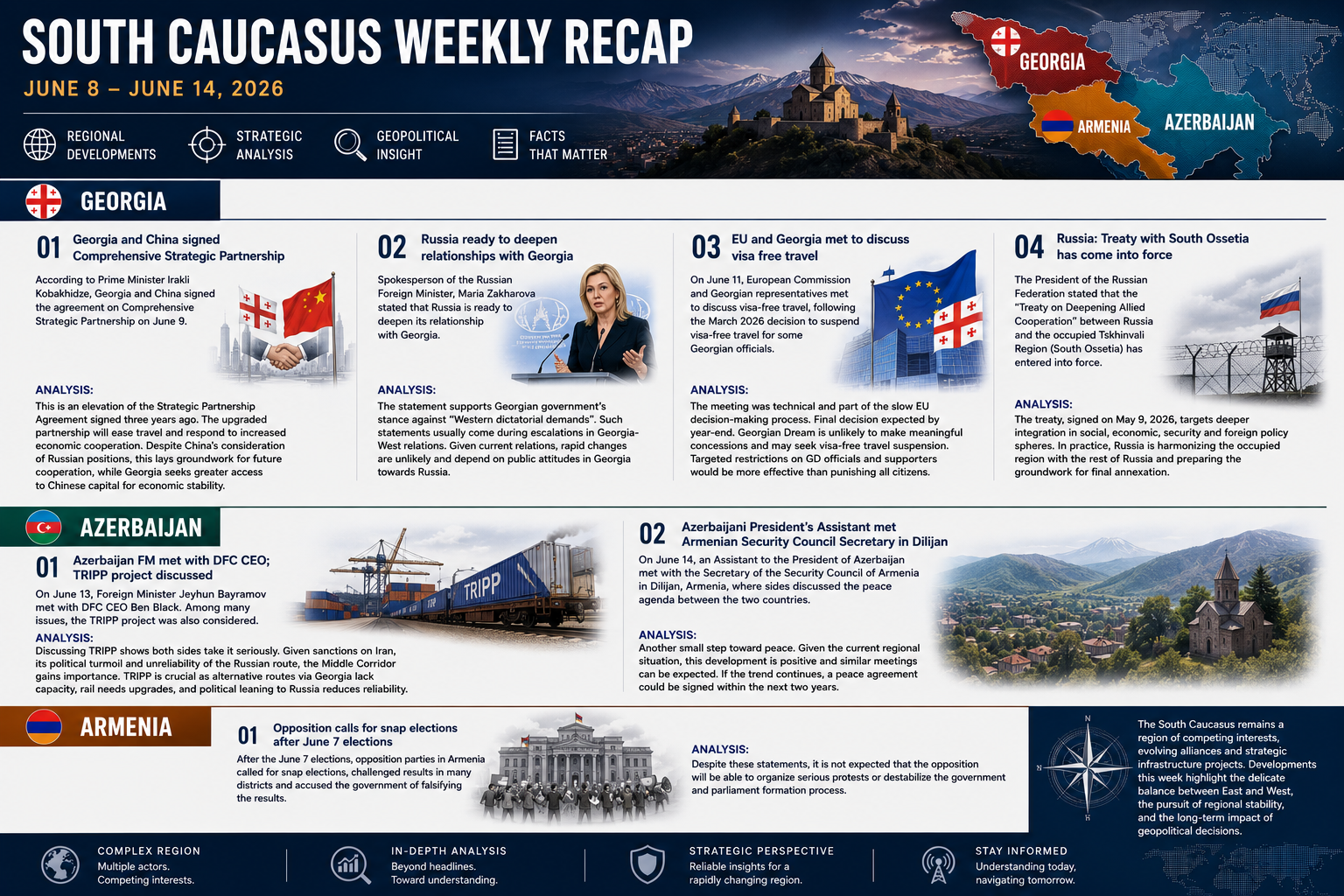
Weekly Recap – June 8 – 14 / 2026
🇬🇪
Georgia
Item 01
According to Prime Minister Irakli Kobakhidze, Georgia and China signed the Agreement on Comprehensive Strategic Partnership on June 9.
Analysis
This is an elevation of the Strategic Partnership Agreement signed three years ago. The upgraded partnership will ease travel and respond to the increased economic ties between the two countries. Despite the fact that China, on the international level, always takes Russian positions on Georgia into account and never does anything that may hurt Russia’s major interests in the region, this still lays groundwork for future partnership — when Russia leaves the region, China will be well prepared. On the other side, the Georgian government hopes to gain access to Chinese capital to ensure economic stability.
Item 02
Spokesperson of the Russian Ministry of Foreign Affairs, Maria Zakharova, stated that Russia is ready to deepen its relationship with Georgia.
Analysis
The statement was made to verbally support the Georgian government’s statements, in which it mentioned that the country will withstand western dictatorial demands. Russian MFA typically makes these kinds of statements once Georgia’s relationship with western countries reaches some level of escalation. However, due to the current state of relations between Georgia and Russia, swift changes are not expected, as this depends largely on the attitude of the general public in Georgia toward Russia.
Item 03
On June 11, the European Commission and representatives of the Georgian government met to discuss visa-free travel between Georgia and the EU. The meeting was technical in nature and related to the March 2026 European Commission decision, when it suspended visa-free travel for some Georgian officials.
Analysis
Many Georgian analysts and politicians portrayed the meeting as one that would be decisive for the European Commission on the path to making a decision about visa-free travel for Georgians. In reality, it was another meeting on the European Commission’s slow decision-making path. A final decision should be made by the end of the year; depending on the concessions Georgian Dream makes, the European Commission may or may not decide to suspend visa-free travel for Georgian citizens. Considering the previous decisions of Georgian Dream and their attitude, it is most likely that GD will do everything to give the European Commission sufficient grounds to support cancellation of visa-free travel for Georgian citizens. One reason is that they are trying to reduce and possibly sever all connections between Georgians and Europeans, and instead offer Russia and China as alternatives — this would be another goal reached for GD, which they could also sell as European hostility toward Georgian citizens, as they did when the US suspended its strategic partnership with Georgia, launching a campaign claiming that true friends would not end the partnership but would instead grant Georgians visa-free travel to the US.
The best move from the EU would be to differentiate between Georgian citizens and exempt GD members, businesses supporting GD, and their prominent supporters from visa-free travel, along with individuals who have committed crimes in the Schengen area. That would create a clear picture that good behavior is rewarded. Cancelling visa-free travel for the entire country will not trigger a massive uprising leading to the fall of GD — instead, GD will tighten its grip on the population, and Georgians who previously chose the EU for travel and education will largely be pushed toward China as the best available alternative.
If the EU wants Georgian Dream removed from power, it should act quickly and decisively. Otherwise, the government will adapt to gradual sanctions, while the public may feel abandoned and begin looking for alternatives or simply become accustomed to the situation.
Item 04
The President of the Russian Federation stated that the Treaty on Deepening Allied Cooperation between Russia and the occupied Tskhinvali region (South Ossetia) has already entered into force.
Analysis
The treaty, signed on May 9, 2026, officially targets the deepening of integration on a social and economic basis, as well as in the areas of security and foreign policy. What is actually happening, however, is that Russia is trying to harmonize the occupied region with the rest of Russia and lay the groundwork for its final annexation.
🇦🇿
Azerbaijan
Item 01
On June 13, Azerbaijani Foreign Minister Jeyhun Bayramov met with Chief Executive Officer of the U.S. International Development Finance Corporation (DFC), Ben Black. Among many issues discussed, the Trump Route for International Peace and Prosperity (TRIPP) project was also considered.
Analysis
The TRIPP project being among the issues discussed during the meeting shows that both sides are taking it seriously. Considering the existing situation — Iran under sanctions and in constant political turmoil, and the Russian route being unreliable — the Middle Corridor is becoming one of the most important projects in the region. This is especially relevant for TRIPP, as the alternative road route via Georgia lacks capacity, the railway system is in need of immediate upgrades, and the Georgian government’s lean toward Russia makes that route less attractive.
Item 02
On June 14, the Assistant to the Azerbaijani President met with the Armenian Secretary of the Security Council in Dilijan, Armenia. The sides discussed the peace agenda between the two countries.
Analysis
Another small step toward peace was made by both sides. Considering the current situation in the region, this positive development is likely to continue, and similar meetings can be expected. If the trend continues, a peace deal could be signed within the next two years.
🇦🇲
Armenia
Item 01
Following the June 7 elections, opposition parties in Armenia called for snap elections, challenged results in multiple districts, and accused the government of falsifying the results.
Analysis
Despite these statements, it is not expected that the opposition will be able to organize any serious protests or destabilize the government and parliament formation process.