

Weekly Recap – July 13 – 19 / 2026
Georgia
Item 01
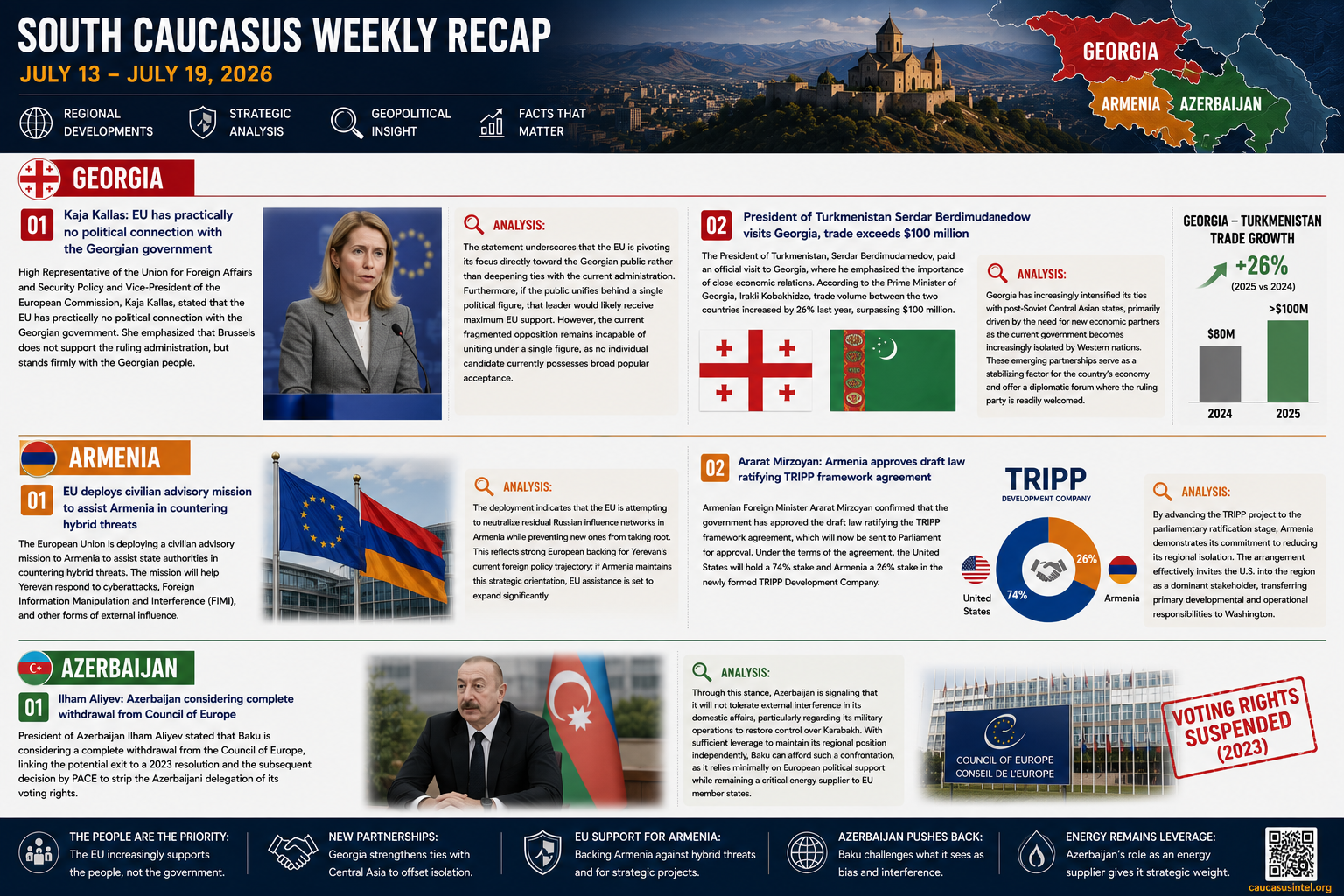
High Representative of the Union for Foreign Affairs and Security Policy and Vice-President of the European Commission, Kaja Kallas, stated that the EU has practically no political connection with the Georgian government. She emphasized that Brussels does not support the ruling administration, but stands firmly with the Georgian people.
Analysis
The statement underscores that the EU is pivoting its focus directly toward the Georgian public rather than deepening ties with the current administration. Furthermore, if the public unifies behind a single political figure, that leader would likely receive maximum EU support. However, the current fragmented opposition remains incapable of uniting under a single figure, as no individual candidate currently possesses broad popular acceptance.
Item 02
The President of Turkmenistan, Serdar Berdimuhamedov, paid an official visit to Georgia, where he emphasized the importance of close economic relations. According to the Prime Minister of Georgia, Irakli Kobakhidze, trade volume between the two countries increased by 26% last year, surpassing $100 million.
Analysis
Georgia has increasingly intensified its ties with post-Soviet Central Asian states, primarily driven by the need for new economic partners as the current government becomes increasingly isolated by Western nations. These emerging partnerships serve as a stabilizing factor for the country’s economy and offer a diplomatic forum where the ruling party is readily welcomed.
Armenia
Item 01
The European Union is deploying a civilian advisory mission to Armenia to assist state authorities in countering hybrid threats. The mission will help Yerevan respond to cyberattacks, Foreign Information Manipulation and Interference (FIMI), and other forms of external influence.
Analysis
The deployment indicates that the EU is attempting to neutralize residual Russian influence networks in Armenia while preventing new ones from taking root. This reflects strong European backing for Yerevan’s current foreign policy trajectory; if Armenia maintains this strategic orientation, EU assistance is set to expand significantly.
Item 02
Armenian Foreign Minister Ararat Mirzoyan confirmed that the government has approved the draft law ratifying the TRIPP framework agreement, which will now be sent to Parliament for approval. Under the terms of the agreement, the United States will hold a 74% stake and Armenia a 26% stake in the newly formed TRIPP Development Company.
Analysis
By advancing the TRIPP project to the parliamentary ratification stage, Armenia demonstrates its commitment to reducing its regional isolation. The arrangement effectively invites the U.S. into the region as a dominant stakeholder, transferring primary developmental and operational responsibilities to Washington.
Azerbaijan
Item 01
President of Azerbaijan Ilham Aliyev stated that Baku is considering a complete withdrawal from the Council of Europe, linking the potential exit to a 2023 resolution and the subsequent decision by PACE to strip the Azerbaijani delegation of its voting rights.
Analysis
Through this stance, Azerbaijan is signaling that it will not tolerate external interference in its domestic affairs, particularly regarding its military operations to restore control over Karabakh. With sufficient leverage to maintain its regional position independently, Baku can afford such a confrontation, as it relies minimally on European political support while remaining a critical energy supplier to EU member states.