

Weekly Recap – June 15 – 21 / 2026
🇬🇪
Georgia
Item 01
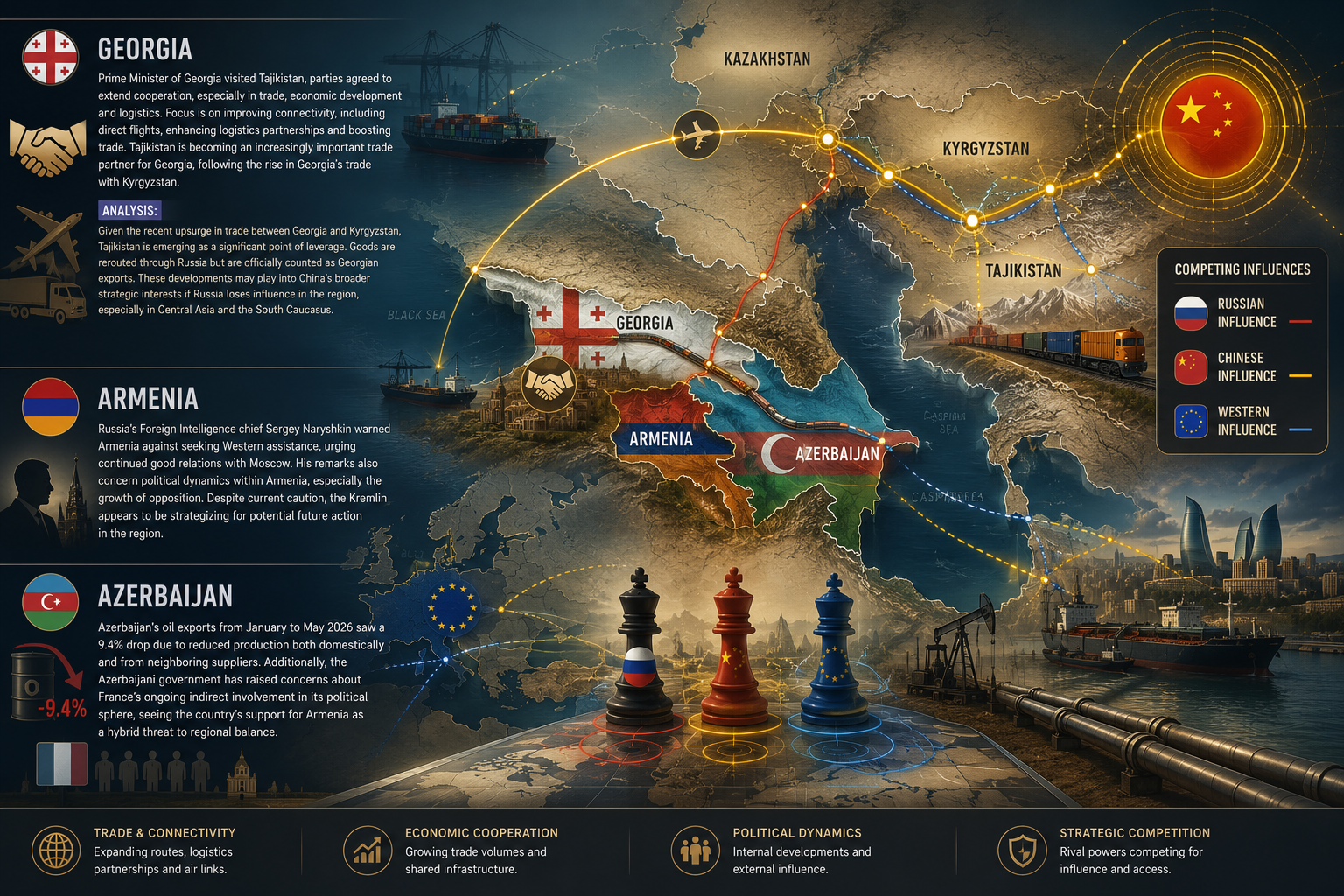
The Prime Minister of Georgia paid an official visit to Tajikistan, where both parties agreed to extend bilateral cooperation, specifically focusing on trade and economic relations, accelerating work on establishing direct flights, and increasing cooperation in logistics.
Analysis
Following the recent drastic spike in Georgia’s trade volume with Kyrgyzstan, Tajikistan is emerging as another vital link. Empirical data suggests that these goods are largely being rerouted to Russia, despite officially being documented as trade with Georgia. In the long term, these connectivity frameworks may ultimately serve Chinese strategic interests; if Russia fails to hold its ground in Ukraine and consequently loses its historical leverage over Central Asia and the South Caucasus, Beijing will be positioned to inherit a fully built-in, operational logistics network.
Item 02
The Council of Europe Commissioner for Human Rights, Michael O’Flaherty, issued a statement recommending that the Georgian government repeal or thoroughly review recent legislative amendments impacting freedom of expression and association. He also stated that the Georgian government should broaden the scope of investigations into credible allegations of police ill-treatment during recent protests.
Analysis
Georgian Dream leadership denounced the statements, maintaining that everything was done legally and they are not going to make any changes to the laws. This response was expected, and there is effectively zero probability that the ruling party will alter its stance, which eventually will lead to a fresh wave of international sanctions targeting the government and individual officials.
Item 03
The European Parliament strongly criticized the Georgian government and its “anti-European path” in its resolution on the Report on the 2025 Commission report on Georgia. The text noted that the decisions of the Georgian government regarding sanctions on Russia are now less compliant with EU decisions. The Parliament also called on the Hungarian government to lift its blockade on imposing EU-wide targeted sanctions against Bidzina Ivanishvili and the leadership of Georgian Dream, while demanding the unconditional release of all persons detained on political grounds.
Analysis
The resolution underscores that the European bureaucracy now has a completely transparent view of where Georgia is heading, and this formal assessment can easily be used as the political and legal justification required by member states to implement harsher restrictive measures.
🇦🇲
Armenia
Item 01
The Director of Russia’s Foreign Intelligence Service, Sergey Naryshkin, stated that Armenia would be making a grave mistake if it chooses to rely on Western help. He also evaluated the recent elections, stating that lively political processes would continue in the country, and emphasized the importance of maintaining a good relationship with Yerevan.
Analysis
These remarks function as a dual-track signal: they serve as an explicit cautionary warning to Yerevan while indicating that Moscow is not currently prepared to take immediate, overt retaliatory actions. Instead, Russia appears to be waiting for a more opportune tactical window. The most probable outcome is that the Armenian opposition will enter parliament and try to systematically disrupt Prime Minister Nikol Pashinyan’s policies from within. This strategy secures official state funding for opposition factions while granting Moscow proxy access to internal parliamentary documentation and government secrets, keeping them prepared to act when regional circumstances shift.
🇦🇿
Azerbaijan
Item 01
From January to May 2026, Azerbaijan transported over 10.556 million tons of crude oil via the Baku–Tbilisi–Ceyhan (BTC) main export pipeline, marking a 9.4% decrease compared to the same period last year.
Analysis
The primary driver behind the reduced transit volume is a baseline production slowdown within Azerbaijan’s own active fields, compounded by a minor reduction in crude volumes exported into the system from third-party partners in Kazakhstan and Turkmenistan.
Item 02
According to the Temporary Commission against Foreign Interference and Hybrid Threats of the Azerbaijani Parliament, France is actively continuing a coordinated hybrid campaign against Azerbaijan.
Analysis
In reality, Paris is not waging an official, state-level strategic war against Baku. Rather, French institutional pushback is primarily driven by domestic politicians heavily influenced by the influential Armenian diaspora lobby, resulting in highly visible verbal and diplomatic condemnation. Concurrently, however, France’s tangible support for Armenia’s Western integration and its active assistance in rebuilding the Armenian military do constitute an indirect, material challenge to Azerbaijani regional security interests.