

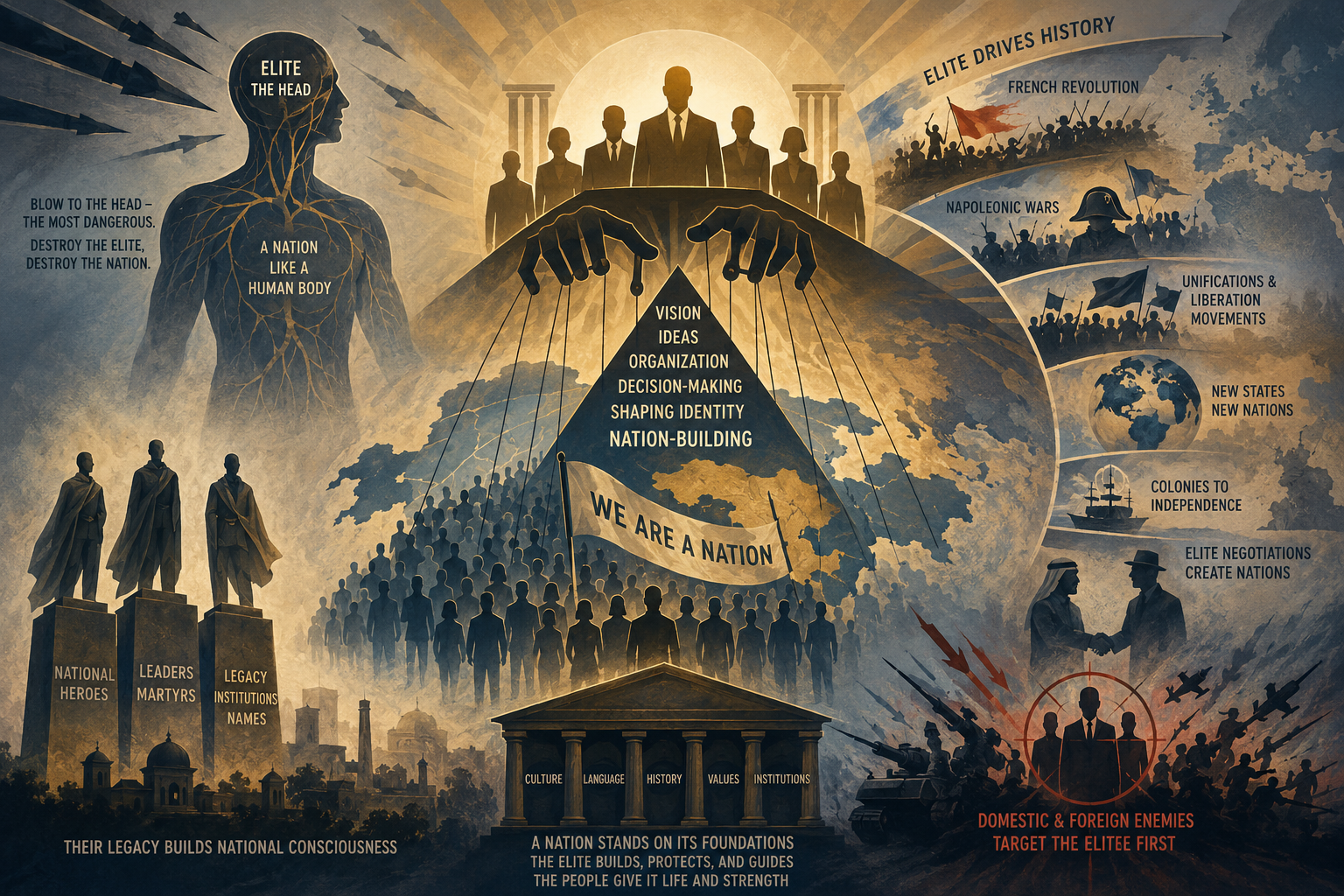
How crucial are elites in building a nation?
How did the nation, nationalism, and all the attributes that characterize modern states come into existence? Who first conceived the idea of telling the masses, “You are a nation, and you must have your own independent state because you possess a distinct identity”? The answer, of course, is the elite. It was those individuals within a given territory—among a people sharing a distinct culture—who were recognized as educated; the kind of people one would consult when seeking a better outcome.
People always gravitate toward individuals who are more educated, resourceful, strong, and renowned than themselves. They adorn them with various epithets, playing up to their ‘betters’ in the hope that, through this dynamic, they themselves might improve. In doing so, they essentially create the elite. The elite, in turn, gradually begins to feel its own superiority. Realizing the power it has acquired, it attempts to organize society in whatever way it deems best for the public. If this elite is truly intelligent and genuinely educated—rather than merely an accidental product of the times—it will be able to take society’s true capabilities into account and methodically improve them. And along this path, even the creation of a nation might prove to be a highly useful endeavor.
Now, turning to the actual importance of the elite, let us compare the state to a human body. A human being cannot survive without a head, and blows directed at the head are always the most dangerous. Regardless of whether this head is brimming with intellect and knowledge or is completely hollow, its destruction is inevitably lethal. However, a smart head can distinguish between a needle offered by a drug addict and one administered by a doctor. The elite functions in exactly this same capacity within a society. It is the entity capable of making decisions about what is best for the populace—decisions upon which its own continued well-being ultimately depends.
It is precisely because of this immense importance that in any clash between nations, it is the elite who has the first say, and it is the opponent’s elite that an enemy seeks to destroy first. The crucial role of the elite in nation-building is clearly evidenced by the very existence of the “national hero” status. True, an individual may not have been part of the elite before earning this title, but once they do, they unequivocally join its ranks. The visible manifestation of this societal reverence is the myriad of institutions and public spaces proudly bearing their names.
It is evident that a segment of today’s Georgian elite is actively working to cultivate a national consciousness among Georgians. This effort is clearly manifested in the way historical figures from the Middle Ages—or even earlier—are retrospectively proclaimed as “national figures,” despite the fact that the very concept of nationalism was completely non-existent during their time.
The revival of nationalism in Georgia is intrinsically linked to the name of Ilia Chavchavadze. It was he who first began introducing political nationalism to the country through the concept of a National-Democratic Party. However, he was never given the chance to establish it; Ilia was assassinated at Tsitsamuri, and his idea was killed alongside him. Consequently, the creation of the National-Democratic Party in Georgia was delayed until 1917, when Spiridon Kedia and his associates finally managed to build it. Decades later, Gia Chanturia—one of the most prominent leaders of Georgian national democracy and the liberation movement of the 1980s and 90s—was assassinated in 1994, dealing yet another devastating blow to Georgian nationalism. About a year prior to that, Zviad Gamsakhurdia, an outstanding leader of the national movement, was also killed. And even earlier, in 1989, Merab Kostava, another distinguished figure of the Georgian national liberation movement, died under suspicious circumstances (or, at the very least, the elite continues to tell the public that the exact causes of his death remain unclear, with the Public Broadcaster even dedicating a documentary to his passing—an institution that is, at least nominally, considered a shaper of national public opinion).
All the aforementioned facts clearly demonstrate the immense significance of the elite in nation-building, as well as the profound threat it poses to both domestic and foreign enemies. Notably, among these three figures, there were both radical and moderate nationalists; yet, all three ultimately fell victim to political assassination. Consequently, fervent nationalist movements in Georgia began to wane, and the country’s developmental trajectory shifted distinctly away from the vision promised by these leaders and their followers. Today, their legacy is scarcely visible, and the Georgian National-Democratic Party holds virtually no significant presence on the modern political stage.
During the French Bourgeois Revolution, the elite undeniably played a leading role in forging the French nation; in fact, the very term “nationalism” emerged at its onset. It is here that we clearly see how the elite altered the trajectory of the people’s development—transforming them into a nation by explicitly telling them that they were one. This transformation was driven by the confrontation with the old regime, a struggle brought about by the rapid advancement of trade, navigation, and industry. These new economic dynamics demanded an entirely new form of interaction between the traditional rulers and the newly educated, increasingly wealthy class—the emerging new elite.
During this confrontation, the new elite needed to bestow a new status upon the people. While individuals had previously been identified by the feudal lords who owned them, the new elite had to forge an entirely new identity for the masses. This necessity gave rise to the concept of the “citizen.” Following the revolution, everyone was designated a citizen of France (a bourgeois or bürger), and the revolution itself became known as the Bourgeois—or civic—Revolution. The old elite was ousted, and the new elite declared themselves the defenders of the people and of France, rather than protectors of the king and the feudal lords.
Nationalism, particularly French nationalism, was further solidified by the Napoleonic Wars. Napoleon forged a new military elite that the public revered and obeyed. Although Napoleon himself largely rejected rigid ideologies and governing doctrines, his actions undeniably bolstered French nationalism, not least through the annexation of new territories into the French domain. Consequently, the Napoleonic Wars catalyzed the rapid spread of nationalist ideas across Europe. This diffusion was heavily spurred by France’s swift advancement following the abolition of royal authority and feudalism. Observing this, the rest of Europe recognized that France’s progress was the direct result of dismantling the old order—a transformation they largely attributed to the power of nationalism. The ultimate outcomes of this realization included the creation of the German Customs Union (Zollverein) and the bourgeois-nationalist revolutions of 1848–1849.
The unification of Italy—which was dictated entirely by the elite—began during this same period. Similarly, the emergence of liberation movements in Eastern European countries and the struggle against the Spanish colonial regime in South America culminated in the formation of new, independent states. Today, figures like Simón Bolívar and José de San Martín are hailed as liberators, and within the territories they freed, we can now unequivocally say that several distinct nations exist. The elite’s role in the creation of the United States is equally apparent. There, the united opposition of the elite and the people against the ruling power led to American independence. Today, it is an undeniable fact that Americans possess a distinct identity and can rightfully be called a nation.
A prime example of the elite’s crucial role in nation-building is the emergence of the Arab states. When the British took an interest in the Arab territories of the Middle East, they approached the local sheikhs—the established elite—and settled matters directly with them. As a result, Kuwait was separated from Iraq, and today we have distinct Kuwaiti and Iraqi nations. This outcome materialized despite the fact that the people themselves could have easily risen up to declare that they were one and the same, as there was virtually no substantive difference between them at the time. Yet another compelling example is the ongoing debate over whether the Kurds constitute a nation. Had Abdullah Öcalan not been captured, this question might not even be up for debate today. Following Öcalan’s arrest, Kurdish separatism weakened significantly. Ultimately, in 2013, Öcalan declared from prison that their goal should instead be the democratization of the entirety of Turkey. Such a shift inevitably leads to reduced tensions and an increase in the influence of globalization—a force widely considered to be the primary enemy of nationalism.
Ultimately, the conclusion is as follows: the role of the elite is of paramount importance. It matters little whether the demand for nation-building emerges from below—from the people—or whether the elite orchestrates it for the sake of greater stability. The undeniable fact remains that the driving levers of this entire process rest firmly in the hands of the elite.