

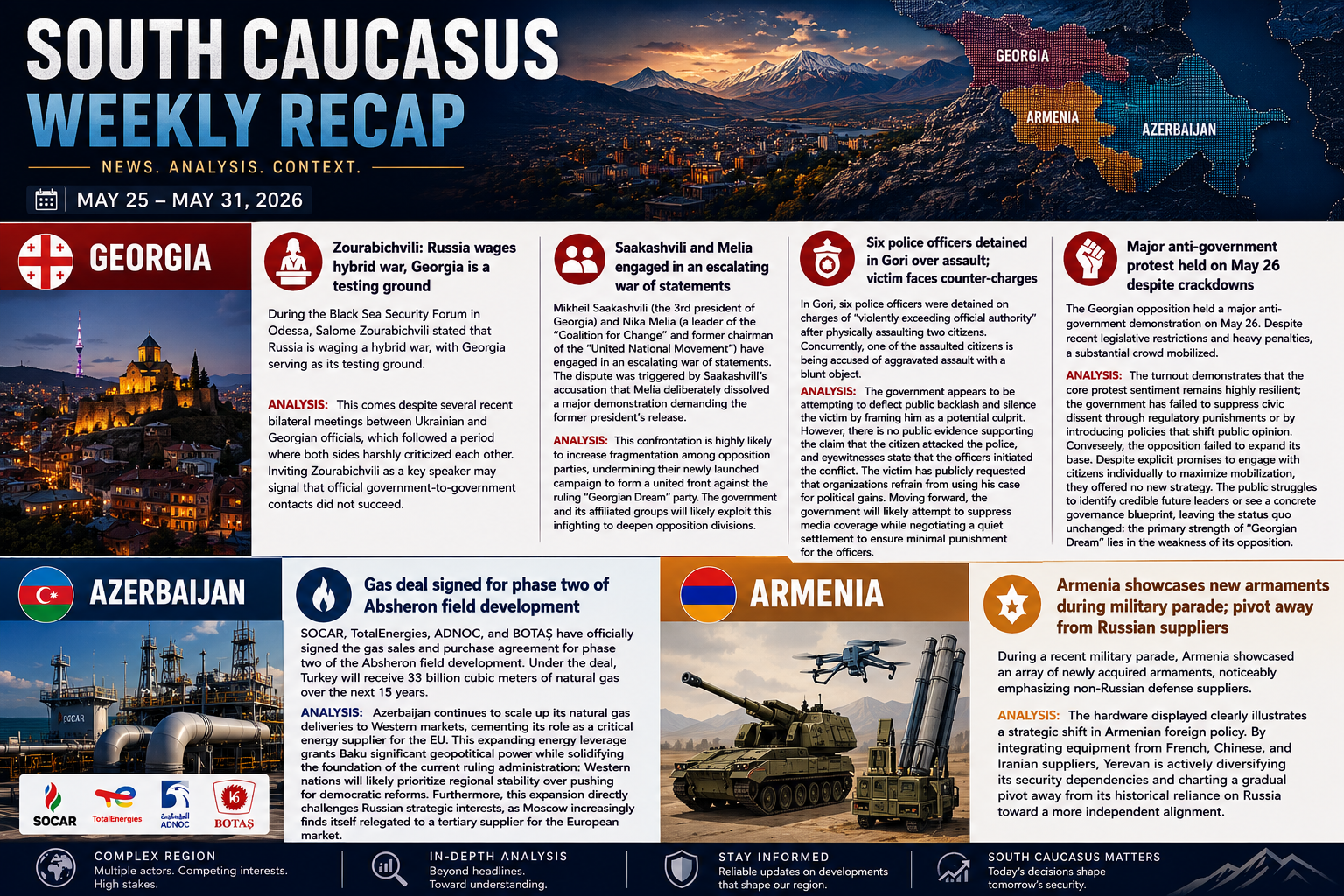
Weekly Recap – May 25 – 31 / 2026
Georgia
Item 01
During the Black Sea Security Forum in Odessa, Salome Zourabichvili (the 5th President of Georgia) stated that Russia is waging a hybrid war, with Georgia serving as its testing ground.
Analysis
This comes despite several recent bilateral meetings between Ukrainian and Georgian officials, which followed a period where both sides harshly criticized each other. Because Zourabichvili is widely viewed as an anti-government voice who positions herself as the only legal president of the country, inviting her as a key speaker may signal that the official government-to-government contacts did not succeed.
Item 02
Mikheil Saakashvili (the 3rd President of Georgia) and Nika Melia (a leader of the “Coalition for Change” and former chairman of the “United National Movement”) have engaged in an escalating war of statements. The dispute was triggered by Saakashvili’s accusation that Melia deliberately dissolved a major demonstration demanding the former president’s release.
Analysis
This confrontation is highly likely to increase fragmentation among opposition parties, undermining their newly launched campaign to form a united front against the ruling “Georgian Dream” party. The government and its affiliated political groups will likely exploit this infighting to deepen opposition divisions.
Item 03
In Gori, six police officers were detained on charges of “violently exceeding official authority” after physically assaulting two citizens. Concurrently, one of the assaulted citizens is being accused of aggravated assault with a blunt object.
Analysis
The government appears to be attempting to deflect public backlash and silence the victim by framing him as a potential culprit. However, there is no public evidence supporting the claim that the citizen attacked the police, and eyewitnesses state that the officers initiated the conflict. The victim has publicly requested that organizations refrain from using his case for political gains. Moving forward, the government will likely attempt to suppress media coverage while negotiating a quiet settlement between the parties to ensure the officers receive minimal punishment.
Item 04
The Georgian opposition held a major anti-government demonstration on May 26. Despite recent legislative restrictions and heavy penalties, a substantial crowd mobilized.
Analysis
The turnout demonstrates that the core protest sentiment remains highly resilient; the government has failed to suppress civic dissent through regulatory punishments or by introducing policies that shift public opinion. Conversely, the opposition failed to expand its base. Despite explicit promises to engage with citizens individually to maximize mobilization, they offered no new strategy. Because the public struggles to identify credible future leaders within the current opposition lineup or see a concrete governance blueprint, the status quo remains unchanged: the primary strength of “Georgian Dream” continues to lie in the weakness of its opposition.
Azerbaijan
Item 01
SOCAR, TotalEnergies, ADNOC, and BOTAŞ have officially signed the gas sales and purchase agreement for phase two of the Absheron field development. Under the deal, Turkey will receive 33 billion cubic meters of natural gas over the next 15 years.
Analysis
Azerbaijan continues to scale up its natural gas deliveries to Western markets, cementing its role as a critical energy supplier for the EU. This expanding energy leverage grants Baku significant geopolitical power while solidifying the foundation of the current ruling administration; Western nations will likely prioritize regional stability over pushing for democratic reforms. Furthermore, this expansion directly challenges Russian strategic interests, as Moscow increasingly finds itself relegated to a tertiary supplier for the European market.
Armenia
Item 01
During a recent military parade, Armenia showcased an array of newly acquired armaments, noticeably emphasizing non-Russian defense suppliers.
Analysis
The hardware displayed clearly illustrates a strategic shift in Armenian foreign policy. By integrating equipment from French, Chinese, and Iranian suppliers, Yerevan is actively diversifying its security dependencies and charting a gradual pivot away from its historical reliance on Russia toward a more independent alignment.