

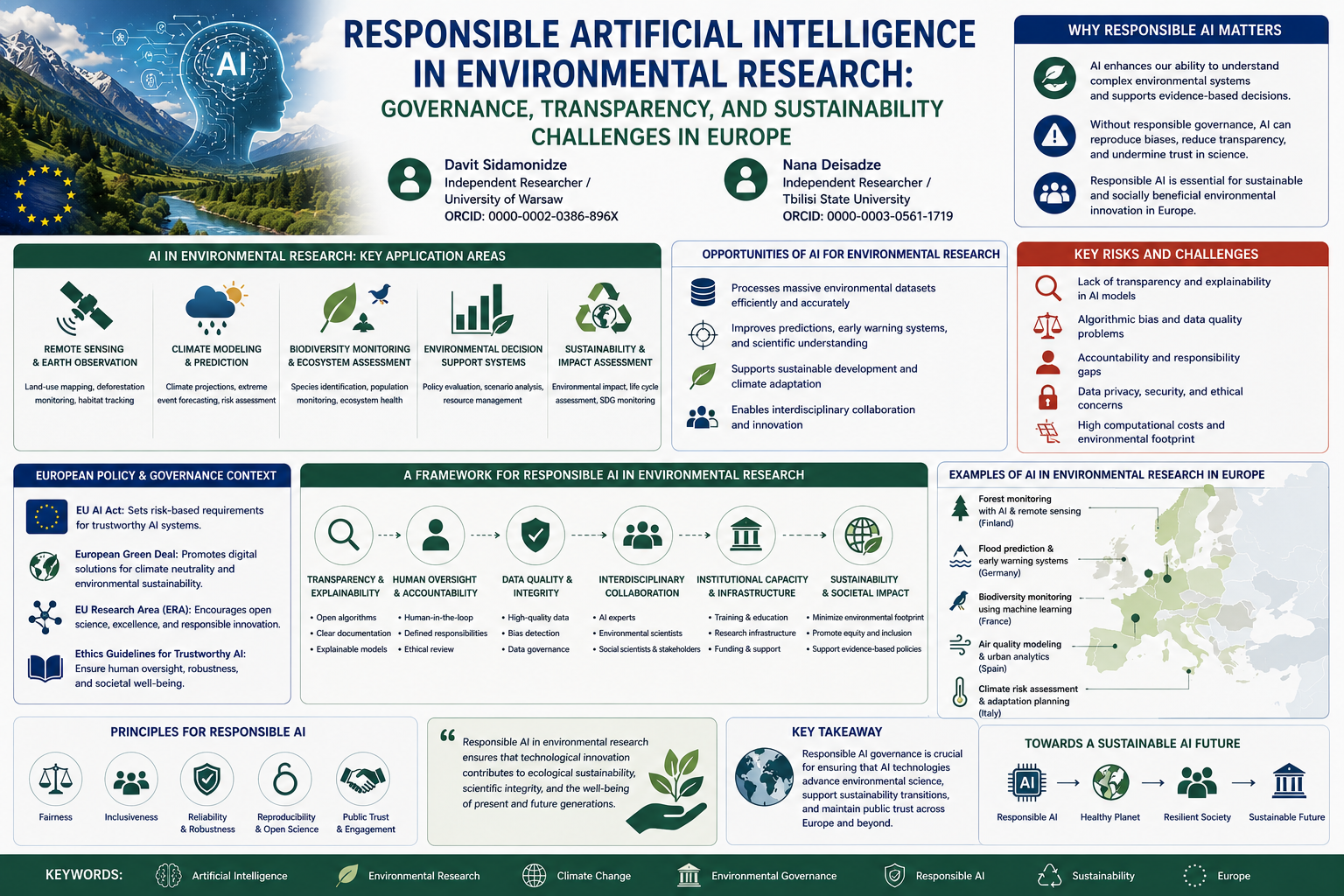
Responsible Artificial Intelligence in Environmental Research: Governance, Transparency, and Sustainability Challenges in Europe
Responsible Artificial Intelligence in Environmental Research: Governance, Transparency, and Sustainability Challenges in Europe
Davit Sidamonidze
Independent Researcher / University of Warsaw
ORCID: 0000-0002-0386-896X
Nana Deisadze
Independent Researcher / Tbilisi State University
ORCID: 0000-0003-0561-1719
Abstract
Artificial intelligence (AI) increasingly influences environmental research through applications in climate modeling, remote sensing, biodiversity monitoring, ecosystem assessment, and environmental decision support. While AI offers unprecedented opportunities for processing large environmental datasets and improving scientific understanding, it also introduces important challenges concerning transparency, explainability, accountability, bias, and research integrity. This paper examines the emergence of responsible AI practices within European environmental research. Drawing upon European policy frameworks, environmental governance literature, and recent developments in trustworthy artificial intelligence, the study analyzes the opportunities and risks associated with AI adoption in environmental science. Particular attention is given to remote sensing, climate adaptation research, environmental monitoring, and sustainability assessment. The paper proposes a governance framework emphasizing transparency, human oversight, interdisciplinary collaboration, and institutional capacity building. The findings suggest that responsible AI governance is essential for maintaining scientific credibility, supporting evidence-based policymaking, and ensuring socially beneficial environmental innovation.
Keywords: artificial intelligence, environmental research, climate change, environmental governance, responsible AI, sustainability, Europe
- Introduction
Artificial intelligence has become increasingly important in environmental research. Rapid advances in machine learning, deep learning, computer vision, and generative artificial intelligence have transformed the ability of scientists to process large environmental datasets and analyze complex socio-ecological systems.
European environmental research increasingly relies upon:
- satellite observations,
- climate models,
- geospatial data,
- environmental sensors,
- biodiversity monitoring systems,
- ecosystem assessment platforms.
Artificial intelligence provides powerful tools for extracting information from these complex datasets.
At the same time, AI introduces significant challenges concerning:
- transparency,
- reproducibility,
- algorithmic bias,
- accountability,
- ethics.
Environmental research directly influences public policies, climate adaptation strategies, and sustainability transitions. Therefore, ensuring trustworthy AI applications becomes particularly important.
This paper addresses three questions:
- How is AI transforming environmental research?
- What governance challenges emerge from AI adoption?
- How can responsible AI principles support environmental science?
- Literature Review
2.1 AI and environmental science
Artificial intelligence applications have expanded rapidly across environmental sciences.
Applications include:
- climate modeling,
- species distribution modeling,
- remote sensing,
- environmental forecasting,
- land-use analysis,
- disaster monitoring.
Rolnick et al. (2019) identify numerous opportunities where AI can contribute to climate mitigation and adaptation.
Machine learning techniques increasingly support environmental decision-making and risk assessment.
2.2 Environmental governance and digital transformation
Environmental governance increasingly incorporates digital technologies.
Digital environmental governance includes:
- environmental information systems,
- geospatial platforms,
- decision-support tools,
- citizen science applications.
AI represents the next stage of this digital transformation.
However, technological innovation must remain compatible with principles of transparency, participation, and accountability.
2.3 Responsible AI
The European approach to AI governance emphasizes trustworthy and human-centered AI (European Commission, 2019).
Responsible AI includes:
- transparency,
- accountability,
- fairness,
- robustness,
- explainability,
- human oversight.
These principles are particularly relevant in environmental decision-making because environmental policies affect both ecosystems and communities.
- Methodology
This study employs qualitative policy analysis and literature review methods.
Sources include:
- European AI governance documents,
- environmental policy frameworks,
- AI ethics literature,
- environmental science publications.
The analysis identifies key governance dimensions affecting AI use within environmental research.
- AI Applications in Environmental Research
4.1 Remote sensing and Earth observation
Remote sensing represents one of the most important environmental applications of AI.
Machine learning supports:
- land cover classification,
- forest monitoring,
- wildfire detection,
- deforestation assessment,
- agricultural monitoring.
Satellite platforms generate enormous quantities of data requiring automated processing.
Deep learning approaches increasingly improve classification accuracy.
4.2 Climate modeling
AI assists climate scientists by:
- reducing computational costs,
- improving prediction accuracy,
- identifying complex patterns.
Machine learning complements traditional climate models by identifying nonlinear relationships.
4.3 Biodiversity monitoring
Computer vision and acoustic monitoring support biodiversity assessment.
Applications include:
- species identification,
- habitat monitoring,
- ecosystem health assessment.
These technologies may substantially improve conservation efforts.
4.4 Environmental risk assessment
AI increasingly contributes to:
- flood prediction,
- drought monitoring,
- wildfire forecasting,
- disaster risk management.
Early warning systems benefit from large-scale environmental data analysis.
- Governance Challenges
5.1 Black-box models
Many AI models operate as complex systems that are difficult to interpret.
Environmental policymakers may hesitate to trust decisions generated by opaque algorithms.
Explainability therefore becomes essential.
5.2 Data bias
Environmental datasets often contain:
- geographical biases,
- temporal biases,
- socioeconomic biases.
These biases may influence AI outputs.
Developing countries and remote regions frequently remain underrepresented.
5.3 Reproducibility
AI models often depend on:
- proprietary software,
- unavailable datasets,
- computational resources.
This complicates scientific replication.
Open science principles become increasingly important.
5.4 Ethical concerns
Environmental AI may influence:
- land-use decisions,
- conservation priorities,
- climate adaptation investments.
These decisions involve ethical and political considerations.
Human oversight remains necessary.
- European Policy Context
The European Union increasingly promotes trustworthy AI.
Relevant initiatives include:
- European AI Act,
- European Green Deal,
- Open Science policies,
- European Research Area.
Environmental sustainability itself has become a component of responsible AI.
AI systems consume energy and computational resources.
Therefore, environmental AI should itself be environmentally sustainable.
- A Governance Framework for Environmental AI
Four governance pillars are proposed.
7.1 Transparency
Researchers should document:
- datasets,
- models,
- assumptions,
- limitations.
Transparent reporting improves credibility.
7.2 Explainability
Environmental decisions require understandable evidence.
Explainable AI methods support policy applications.
7.3 Human oversight
Scientists and policymakers must retain responsibility.
AI should support decisions rather than replace expertise.
7.4 Capacity building
Environmental researchers increasingly require:
- AI literacy,
- computational skills,
- ethical training.
Interdisciplinary education becomes essential.
- Discussion
AI offers significant opportunities for environmental research.
Benefits include:
- improved monitoring,
- faster analysis,
- better predictions,
- increased efficiency.
However, environmental governance requires public trust.
Opaque algorithms may undermine confidence.
European institutions possess strong foundations for responsible AI because they emphasize:
- sustainability,
- participation,
- ethics,
- transparency.
Collaborative networks can facilitate the development of shared standards.
- Conclusion
Artificial intelligence is becoming an essential component of environmental research.
Its applications span climate science, biodiversity monitoring, remote sensing, and environmental risk assessment.
Nevertheless, AI adoption must be accompanied by robust governance frameworks emphasizing transparency, accountability, and human oversight.
Responsible AI can strengthen environmental science while supporting evidence-based sustainability policies.
Future research should examine:
- AI impacts on environmental decision-making,
- institutional governance models,
- interdisciplinary collaboration,
- public perceptions of environmental AI.
Responsible environmental AI may become a critical component of Europe’s sustainability transition.
References
European Commission. (2019). Ethics guidelines for trustworthy AI. European Commission.
European Commission. (2020). A European strategy for data. European Commission.
IPCC. (2023). Climate change 2023: Synthesis report. IPCC.
Keeso, A. (2014). Big data and environmental sustainability. Ecological Informatics, 21, 13–21.
Miller, T. (2019). Explanation in artificial intelligence. Artificial Intelligence, 267, 1–38.
OECD. (2019). OECD principles on artificial intelligence. OECD Publishing.
Rolnick, D., Donti, P., Kaack, L., Kochanski, K., Lacoste, A., Sankaran, K., Ross, A., Milojevic-Dupont, N., Jaques, N., Waldman-Brown, A., Luccioni, A., Maharaj, T., Sherwin, E., Mukkavilli, S., Kording, K., Gomes, C., Ng, A., Hassabis, D., Platt, J., … Bengio, Y. (2019). Tackling climate change with machine learning. arXiv preprint arXiv:1906.05433.
UNESCO. (2021). Recommendation on the ethics of artificial intelligence. UNESCO.
United Nations Environment Programme. (2022). Digital transformation for sustainability. UNEP.
Vinuesa, R., Azizpour, H., Leite, I., Balaam, M., Dignum, V., Domisch, S., Felländer, A., Langhans, S., Tegmark, M., & Fuso Nerini, F. (2020). The role of artificial intelligence in achieving the Sustainable Development Goals. Nature Communications, 11(233), 1–10.