

Weekly Recap – July 27 – Aug 2 / 2026
Georgia
Item 01
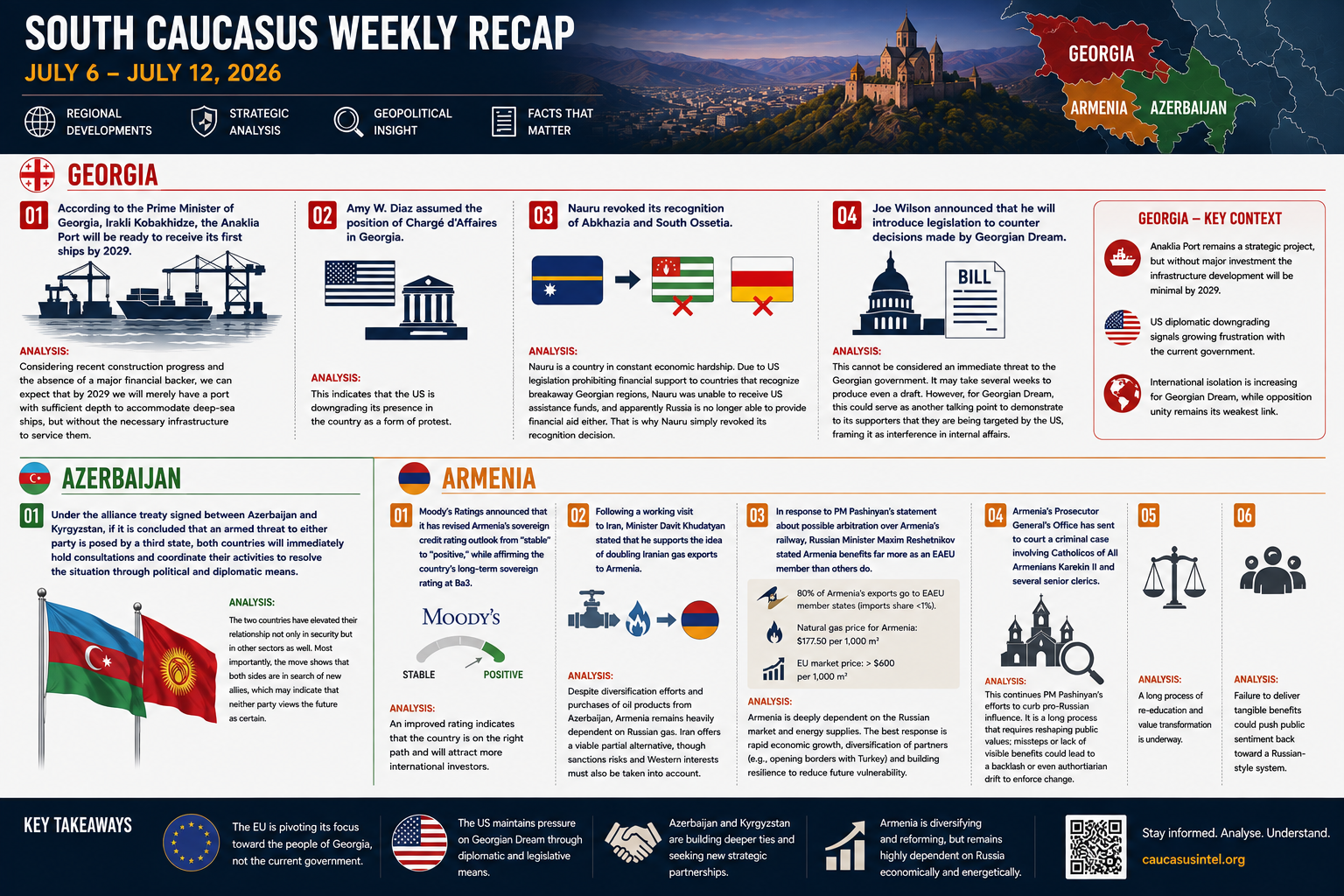
According to the Prime Minister of Georgia, Irakli Kobakhidze, the Anaklia Port will be ready to receive its first ships by 2029.
Analysis
Considering recent construction progress and the absence of a major financial backer, we can expect that by 2029 we will merely have a port with sufficient depth to accommodate deep-sea ships, but without the necessary infrastructure to service them.
Item 02
Amy W. Diaz assumed the position of Chargé d’Affaires in Georgia.
Analysis
This indicates that the US is downgrading its presence in the country as a form of protest.
Item 03
Nauru revoked its recognition of Abkhazia and South Ossetia.
Analysis
Nauru is a country in constant economic hardship. Due to US legislation prohibiting financial support to countries that recognize breakaway Georgian regions, Nauru was unable to receive US assistance funds, and apparently Russia is no longer able to provide financial aid either. That is why Nauru simply revoked its recognition decision.
Item 04
Joe Wilson announced that he will introduce legislation to counter decisions made by Georgian Dream.
Analysis
This cannot be considered an immediate threat to the Georgian government. It may take several weeks to produce even a draft. However, for Georgian Dream, this could serve as another talking point to demonstrate to its supporters that they are being targeted by the US, framing it as interference in internal affairs.
Azerbaijan
Item 01
Under the alliance treaty signed between Azerbaijan and Kyrgyzstan, if it is concluded that an armed threat to either party is posed by a third state, both countries will immediately hold consultations and coordinate their activities to resolve the situation through political and diplomatic means.
Analysis
The two countries have elevated their relationship not only in security but in other sectors as well. Most importantly, the move shows that both sides are in search of new allies, which may indicate that neither party views the future as certain.
Armenia
Item 01
Moody’s Ratings announced that it has revised Armenia’s sovereign credit rating outlook from “stable” to “positive,” while affirming the country’s long-term sovereign rating at Ba3.
Analysis
An improved rating indicates that the country is on the right path and will attract more international investors.
Item 02
Following a working visit to Iran, the Minister of Territorial Administration and Infrastructure, Davit Khudatyan, stated that he supports the idea of doubling Iranian gas exports to Armenia.
Analysis
Despite Armenia’s efforts to diversify its energy supply — and its recent purchases of oil products from Azerbaijan — it remains heavily dependent on Russian natural gas. Developing new pipelines would take years, so while Russian gas supplies are under scrutiny, Iran offers a viable partial alternative. On the other hand, Iran is under international sanctions, and increasing gas imports could damage Armenia’s international standing. To compensate, Armenia may need to accommodate certain Western interests in the region.
Item 03
In response to Prime Minister Nikol Pashinyan’s statement that Armenia’s railway system (managed by a subsidiary of Russian Railways) could become the subject of arbitration proceedings, Russian Economic Development Minister Maxim Reshetnikov stated that Armenia benefits far more as a member of the Eurasian Economic Union (EAEU) than other member states do. While 80% of Armenia’s exports go to the EAEU, its share of member states’ imports is less than 1%. Furthermore, Armenia receives natural gas at $177.50 per 1,000 cubic meters — while EU market prices exceed $600 — and no other partner can offer a better deal.
Analysis
The data cited by Minister Reshetnikov clearly demonstrates how deeply dependent Armenia is on the Russian market and energy supplies. There is no immediate exit from this situation. The most reliable response would be rapid economic growth, ensuring that a closure of the Russian market would not inflict catastrophic damage, while enabling the country to afford market-rate energy and maintain high living standards. Diversifying trade partners — such as opening borders with Turkey under the current geopolitical circumstances — would represent a major breakthrough.
Item 04
Armenia’s Prosecutor General’s Office has sent to court a criminal case involving Catholicos of All Armenians Karekin II and several senior clergymen.
Analysis
This is a continuation of Pashinyan’s agenda to purge pro-Russian influences and prevent the emergence of new pro-Russian factions. This is a long process that requires re-educating the public to adopt new values. Any missteps along the way, or a failure of the new way of life to deliver tangible benefits to the majority of the population, could push public sentiment back toward a Russian-style system. Consequently, current reforms could be rolled back, or Pashinyan might feel forced to establish an authoritarian system to enforce the shift.