

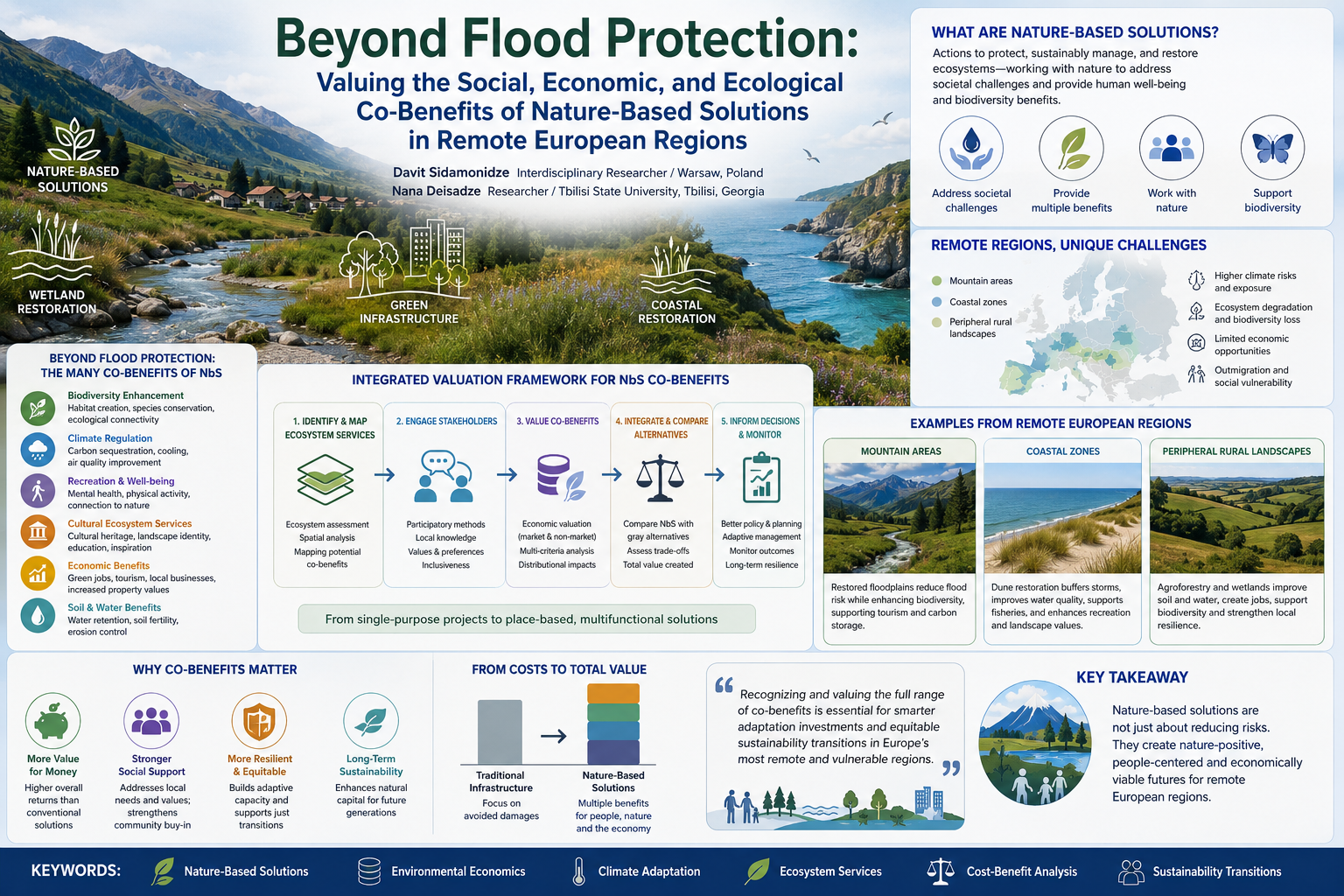
Beyond Flood Protection: Valuing the Social, Economic, and Ecological Co-Benefits of Nature-Based Solutions in Remote European Regions
Beyond Flood Protection: Valuing the Social, Economic, and Ecological Co-Benefits of Nature-Based Solutions in Remote European Regions
Davit Sidamonidze Interdisciplinary Researcher / Warsaw, Poland
Nana Deisadze Researcher / Tbilisi State University, Tbilisi, Georgia
Abstract
Nature-based solutions (NbS) are increasingly promoted across Europe as cost-effective and sustainable approaches for climate change adaptation. While many adaptation projects are justified by their capacity to reduce climate-related risks such as flooding, droughts, and heat stress, a growing body of research suggests that NbS generate a much broader range of social, economic, and ecological benefits. However, these co-benefits remain insufficiently quantified within conventional cost-benefit frameworks, leading to systematic underinvestment in ecosystem-based adaptation measures. This paper explores how environmental-economic valuation methods can be used to assess the multiple co-benefits of nature-based solutions in remote European regions. Drawing on examples from mountain areas, coastal zones, and peripheral rural landscapes, the study proposes an integrated framework combining ecosystem services assessment, participatory stakeholder engagement, spatial analysis, and economic valuation. Particular attention is given to benefits extending beyond local adaptation outcomes, including biodiversity enhancement, recreation, mental health, cultural ecosystem services, carbon sequestration, and regional economic development. The paper argues that recognizing and valuing these co-benefits can significantly improve adaptation planning, strengthen policy support, and contribute to more equitable sustainability transitions across Europe.
Keywords: Nature-Based Solutions, Environmental Economics, Climate Adaptation, Ecosystem Services, Cost-Benefit Analysis, Sustainability Transitions
- Introduction
Europe faces increasing climate-related risks, including floods, droughts, heatwaves, coastal erosion, and biodiversity decline. According to the European Environment Agency (2024), climate impacts are accelerating across both urban and rural regions, requiring substantial investments in adaptation measures.
Traditionally, adaptation strategies have relied heavily on engineered or “grey” infrastructure solutions. Flood walls, drainage systems, and water retention structures remain central components of adaptation planning. However, such approaches are often expensive, inflexible, and unable to address wider sustainability challenges.
Nature-based solutions have emerged as an alternative paradigm.
The European Commission defines nature-based solutions as actions inspired and supported by nature that simultaneously provide environmental, social, and economic benefits while increasing resilience to climate change.
Examples include:
- wetland restoration
- urban green infrastructure
- river re-naturalisation
- peatland restoration
- agroforestry systems
- community forest management
While their adaptation benefits are increasingly recognised, many of their wider societal contributions remain undervalued.
This paper argues that a broader valuation framework is needed to capture the full range of benefits generated by NbS.
- Literature Review
2.1 Nature-Based Solutions and Climate Adaptation
The concept of NbS has gained significant prominence in European climate policy over the last decade (European Commission, 2021).
Unlike conventional engineering solutions, NbS work with ecological processes rather than against them.
Research demonstrates that NbS can:
- reduce flood risks
- improve water retention
- decrease urban heat island effects
- increase ecosystem resilience
Yet adaptation effectiveness alone rarely captures their complete value.
2.2 Ecosystem Services and Co-Benefits
The ecosystem services framework provides a useful foundation for understanding NbS benefits (MEA, 2005).
These benefits can be categorized into:
Provisioning Services
- food production
- water supply
- timber and biomass
Regulating Services
- flood regulation
- carbon sequestration
- climate regulation
- water purification
Cultural Services
- recreation
- tourism
- landscape appreciation
- cultural heritage
Supporting Services
- biodiversity conservation
- soil formation
- nutrient cycling
Many adaptation assessments focus only on regulating services while neglecting broader societal contributions.
2.3 Environmental Economics and Valuation Challenges
Economic valuation seeks to estimate the contribution of environmental resources to human welfare.
Common valuation approaches include:
- contingent valuation
- choice experiments
- travel cost methods
- hedonic pricing
- benefit transfer
However, many co-benefits are difficult to monetize.
Cultural identity, social cohesion, and psychological well-being often remain underrepresented in cost-benefit analyses despite their importance.
- Nature-Based Solutions in Remote European Regions
Remote European regions often face unique sustainability challenges.
These include:
- demographic decline
- ageing populations
- economic marginalisation
- ecosystem degradation
- climate vulnerability
At the same time, such regions contain valuable natural capital.
Mountain regions, for example, provide:
- freshwater resources
- biodiversity hotspots
- carbon storage
- recreational opportunities
Similarly, coastal and peripheral rural areas host ecosystems critical for climate adaptation.
Examples include:
Dutch Coastal Wetlands
Wetland restoration projects enhance flood protection while simultaneously improving biodiversity and tourism opportunities.
Belgian River Restoration Projects
Re-naturalised river corridors reduce flood risk while generating recreational and educational benefits.
Luxembourg Landscape Conservation Initiatives
Agroecological restoration enhances ecosystem services and landscape attractiveness while supporting rural livelihoods.
- An Integrated Valuation Framework
A major challenge for adaptation planning is the integration of multiple benefit categories into decision-making processes.
This paper proposes a four-step framework.
Step 1: Stakeholder Identification
Stakeholders include:
- local communities
- municipalities
- landowners
- NGOs
- businesses
- tourists
Participatory engagement helps identify locally relevant benefits.
Step 2: Ecosystem Services Mapping
Spatial analysis using GIS and remote sensing can identify:
- habitat connectivity
- carbon stocks
- flood regulation capacity
- recreational accessibility
Spatial data allows benefits to be linked to specific locations and populations.
Step 3: Economic Valuation
Different valuation methods should be applied according to benefit type.
For example:
- recreation → travel cost method
- biodiversity → stated preference methods
- property value impacts → hedonic pricing
Step 4: Multi-Criteria Assessment
Not all values should be monetized.
Multi-criteria analysis enables incorporation of:
- social justice considerations
- cultural values
- community preferences
- biodiversity priorities
- Discussion
5.1 From Adaptation Projects to Regional Development
Nature-based solutions should not be viewed solely as adaptation interventions.
They can also function as catalysts for regional development.
For example:
- ecotourism
- green entrepreneurship
- ecosystem restoration employment
- sustainable agriculture
These activities generate economic opportunities while enhancing resilience.
5.2 Rural–Urban Interdependencies
Many NbS implemented in remote regions generate benefits that extend far beyond local communities.
Mountain forests regulate water supplies used by downstream cities.
Wetlands protect urban infrastructure from flooding.
Rural landscapes support recreation and tourism markets.
Consequently, adaptation benefits are often distributed unevenly across territories.
This raises important questions regarding financing mechanisms and benefit sharing.
5.3 Social Equity and Just Adaptation
Adaptation policies increasingly emphasize justice considerations.
The distribution of costs and benefits deserves particular attention.
Questions include:
- Who pays for ecosystem restoration?
- Who benefits from adaptation investments?
- Which communities are prioritised?
Integrating social equity into valuation frameworks remains a key research challenge.
- Policy Implications
Three policy recommendations emerge.
Recommendation 1
Expand adaptation assessments beyond direct climate-risk reduction.
Recommendation 2
Develop standardized approaches for valuing co-benefits.
Recommendation 3
Strengthen participatory governance mechanisms to improve legitimacy and effectiveness.
European adaptation funding programs should encourage integrated assessments that recognise environmental, economic, and social outcomes simultaneously.
- Conclusion
Nature-based solutions offer much more than protection from climate impacts.
They generate diverse co-benefits that contribute to biodiversity conservation, social wellbeing, economic development, and sustainability transitions.
Current appraisal frameworks often underestimate these benefits, leading to suboptimal policy decisions.
An integrated valuation approach that combines environmental economics, ecosystem services assessment, participatory governance, and spatial analysis can provide a more comprehensive understanding of the value of nature-based solutions.
Such approaches are particularly relevant for remote European regions where climate adaptation, regional development, and environmental stewardship are closely interconnected.
References
Costanza, R., et al. (2014). Changes in the global value of ecosystem services. Global Environmental Change, 26, 152–158.
European Commission. (2021). Forging a climate-resilient Europe: EU Strategy on Adaptation to Climate Change. Brussels.
European Environment Agency. (2024). European Climate Risk Assessment. Copenhagen.
MEA. (2005). Millennium Ecosystem Assessment: Ecosystems and Human Well-being. Island Press.
Schaafsma, M., Brouwer, R., Gilbert, A., van den Bergh, J., & Wagtendonk, A. (2013). Estimation of distance-decay functions to account for substitution and spatial heterogeneity in stated preference research. Land Economics, 89(3), 514–537.
Seddon, N., Chausson, A., Berry, P., et al. (2020). Understanding the value and limits of nature-based solutions to climate change and other global challenges. Philosophical Transactions of the Royal Society B, 375(1794).
TEEB. (2010). The Economics of Ecosystems and Biodiversity: Ecological and Economic Foundations. Earthscan.
van den Bergh, J. C. J. M. (2004). Optimal climate policy is a utopia. Ecological Economics, 48(4), 385–393.