

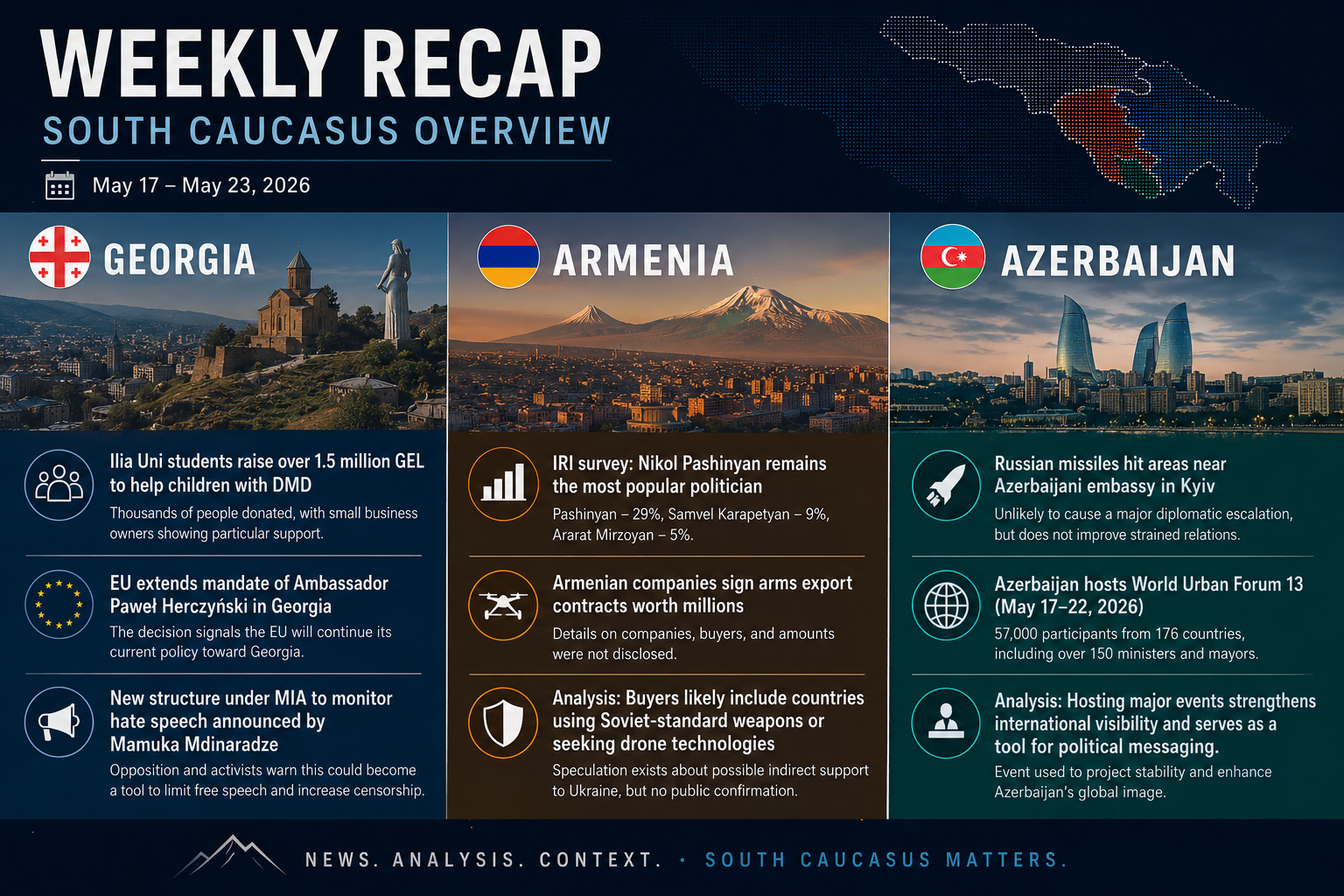
Weekly Recap – May 18 – 24 / 2026
🇬🇪
Georgia
Item 01
Students from Ilia State University raised more than 1.5 million GEL to support children suffering from Duchenne Muscular Dystrophy (DMD), with thousands contributing small donations. Small business owners were especially active in the campaign.
Analysis
While the government declined to provide direct financial support for affected children and their families, the students’ initiative demonstrated strong public solidarity and organizational capacity. The campaign also suggests that anti-government civic activism remains active despite crackdowns, political pressure, and restrictions on political financing. At the same time, recent developments indicate that the government has been more effective at pressuring large businesses, while smaller businesses remain more willing and able to participate in civic and protest-related initiatives.
Item 02
EEAS (European External Action Service) extended the mandate for Ambassador Paweł Herczyński in Georgia.
Analysis
The decision signals that the EU is likely to maintain its current policy toward Georgia despite increasingly hostile rhetoric from the Georgian Dream government toward European officials and institutions.
Item 03
Mamuka Mdinaradze (State Minister for Coordination of Law Enforcement Agencies) stated that a new body will be established within the Ministry of Internal Affairs (MIA) to monitor hate speech in public places.
Reaction
Opposition politicians and activists believe this will serve as another mechanism to limit free speech, potentially leading to internet censorship and a ban on social media.
🇦🇲
Armenia
Item 01
According to a survey by the International Republican Institute (IRI), Prime Minister Nikol Pashinyan remains the country’s most popular politician with 29% support. He is followed by Samvel Karapetyan with 9%, while Foreign Minister Ararat Mirzoyan received 5%.
Analysis
The survey indicates that Pashinyan and his political camp currently remain the strongest contenders in the upcoming parliamentary elections, although public trust in the broader political system remains fragmented.
Item 02
Minister of High-Tech Industry Mkhitar Hayrapetyan announced that three Armenian companies signed contracts to sell armaments worth millions of dollars, without disclosing the names of the involved companies, receiving countries, or the exact financial terms of the deal.
Analysis / Opinion
Considering that the Armenian weapons industry is primarily based on legacy Soviet standards and newly introduced drone technologies, the buyers are likely countries that either still operate Soviet armaments or require drone technology. Furthermore, because many other drone producers provide superior and more cost-effective solutions, Armenia would likely avoid disclosing its drones’ real capabilities through open sales. Given the recent diplomatic contacts between the Ukrainian president and Armenia, it is highly probable that Armenian companies sold artillery shells to Ukraine via third countries. This strategy aims to secure political leverage rather than economic gain; while it does not deplete Armenian domestic stockpiles, it clearly indicates their strategic alignment.
🇦🇿
Azerbaijan
Item 01
Russian missiles struck areas near the Azerbaijani embassy in Kyiv. (The event was widely reported by AZ media and that’s why it’s important.)
Analysis
While this incident may not trigger a new wave of diplomatic confrontation between Azerbaijan and Russia, it will certainly not help improve bilateral relations.
Item 02
Azerbaijan hosted the World Urban Forum (WUF13) from May 17 to May 22, 2026, drawing 57,000 participants from 176 countries, including over 150 ministers and mayors.
Analysis
For the Azerbaijani government, hosting this summit is primarily a tool for soft-power projection and state propaganda.