

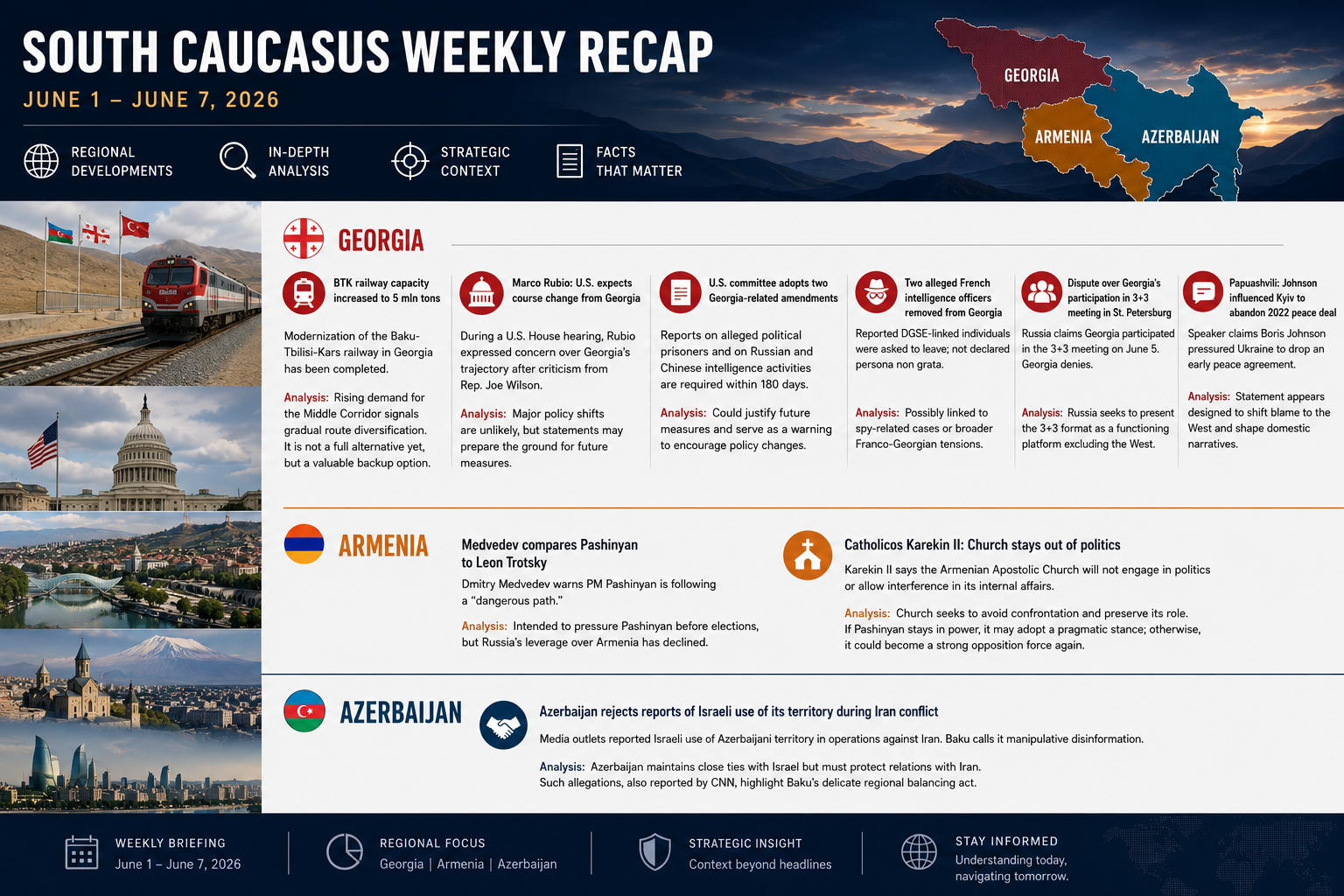
Weekly Recap – June 1 – 7 / 2026
Georgia
Item 01
The modernization works on the Georgian section of the Baku-Tbilisi-Kars (BTK) railway have been completed, increasing the railway’s annual cargo capacity to 5 million tons.
Analysis
The increase in capacity reflects growing demand for the Middle Corridor connecting China and Europe through the South Caucasus. Although the Northern Corridor through Russia remains operational, the expansion may indicate a gradual diversification of trade routes. The Middle Corridor cannot yet be considered a full alternative to either the Northern Corridor or established maritime routes between China and Europe. However, it could serve as an important backup route during disruptions. Furthermore, if implemented, the TRIPP project may further enhance the attractiveness of the Middle Corridor.
Item 02
During a hearing in the U.S. House of Representatives, U.S. Secretary of State Marco Rubio was questioned by Representative Joe Wilson regarding developments in Georgia. Wilson described the Georgian government as illegitimate, accused it of election manipulation, and criticized its relations with Iran and China. Rubio responded by expressing concern over Georgia’s current trajectory and stated that the United States expects a change of course.
Analysis
Given Georgia’s relatively limited role in broader global politics, major and immediate policy shifts from Washington remain unlikely. However, statements of this nature may signal preparations for future measures should circumstances warrant them. Georgia is often cited by Western policymakers as a potential transit route that could facilitate Russian and Iranian sanctions circumvention. However, as long as Western governments retain visibility over trade flows through Georgia and such activities remain only a small component of broader sanctions-evasion networks, a strong response is unlikely. Claims that Georgia serves as a significant supporter of China may be overstated. Georgia’s geopolitical and economic weight is limited, and its relationship with Beijing is primarily driven by the Georgian government’s desire to attract Chinese investment and strengthen economic stability. In this context, Representative Wilson’s references to China may have been intended to reinforce his broader political argument.
Item 03
The U.S. House Armed Services Committee approved two amendments requiring the Department of Defense to prepare reports on alleged political prisoners in Georgia and on Russian and Chinese intelligence activities in the country. The reports should be completed within 180 days.
Analysis
The amendments were initiated by Representative Joe Wilson, who has been actively engaged on Georgian issues. The resulting reports could potentially be used to justify future policy measures toward the Georgian government. The authors are likely to identify evidence supporting concerns about cooperation between Georgian institutions and Russian or Chinese counterparts. At the same time, the initiative may serve as a warning mechanism designed to encourage policy changes before the reports are finalized.
Item 04
According to media reports, two individuals allegedly linked to the French foreign intelligence service (DGSE) were removed from Georgia. They were reportedly not declared persona non grata in order to avoid further diplomatic tensions, but their departure was allegedly requested by the Georgian authorities.
Analysis
Some sources have linked this development to separate espionage-related cases in Georgia involving individuals accused of cooperation with Western intelligence services. However, no publicly available evidence has confirmed such connections. A more plausible explanation may lie in broader tensions within Franco-Georgian relations, particularly France’s support for former President Salome Zourabichvili and its criticism of the Georgian government’s domestic policies.
Item 05
According to the Russian Foreign Ministry, Georgia participated in a meeting of the 3+3 regional platform (Georgia, Armenia, Azerbaijan, Turkey, Iran, and Russia) held in Saint Petersburg on June 5. Georgian officials denied any participation in the meeting.
Analysis
The Russian side appears interested in portraying the 3+3 format as a viable and functioning regional mechanism. Over time, Moscow may seek to use the platform as a tool for strengthening regional cooperation frameworks that exclude Western powers.
Item 06
Speaker of the Georgian Parliament Shalva Papuashvili stated that Russian and Ukrainian delegations had reached a peace agreement approximately two months after the outbreak of the Russia-Ukraine war, but that former British Prime Minister Boris Johnson later traveled to Kyiv and influenced Ukraine to abandon the deal.
Analysis
Since the contents of Johnson’s discussions with Ukrainian officials remain unknown, the claim cannot be independently verified. The statement appears intended to reinforce the government’s narrative that Western actors contributed to prolonging the war and may seek to draw smaller states into geopolitical confrontations.
Item 07
Hungary suspended the issuance of work visas for Georgian citizens, alongside restrictions affecting Armenian and Philippine citizens.
Analysis
The decision is likely linked primarily to domestic Hungarian political considerations and migration policy debates. While the measure may be presented as a response to labor market concerns, it also illustrates how insignificant Georgian workers are for Hungary.
Armenia
Item 01
Deputy Chairman of Russia’s Security Council Dmitry Medvedev stated that Armenian Prime Minister Nikol Pashinyan is following the “dangerous path” of Leon Trotsky.
Analysis
The statement appears intended to pressure Pashinyan ahead of the elections and to signal Moscow’s dissatisfaction with Armenia’s current foreign policy trajectory. However, Russia’s ability to significantly influence Armenian domestic politics has weakened compared to previous years.
Item 02
Catholicos of All Armenians Karekin II stated that the Armenian Apostolic Church does not participate in politics and will not permit interference in its internal affairs.
Analysis
Karekin II has often been perceived as a critic of Prime Minister Pashinyan. However, recent developments suggest that the Church is attempting to avoid direct confrontation with the government while preserving its institutional position. Should Pashinyan remain in power, the Church may gradually adopt a more pragmatic relationship with the state. However, if tensions persist and political circumstances become favorable, it may again emerge as a significant source of opposition.
Azerbaijan
Item 01
Middle East Eye and Haaretz reported on June 5 that Israel allegedly used Azerbaijani territory during operations against Iran. Azerbaijani officials rejected the claims, describing them as misleading and inaccurate.
Analysis
Although Azerbaijan maintains close strategic relations with Israel, it also places considerable importance on stable relations with neighboring Iran. Any confirmed involvement in military actions against Iran would carry substantial political and security risks for Baku. Similar allegations have appeared in international media, including reports by CNN. The Azerbaijani government has consistently denied such claims and sought clarification regarding their publication. The issue highlights the delicate balance Azerbaijan attempts to maintain between its partnership with Israel and its need to preserve workable relations with Iran.