

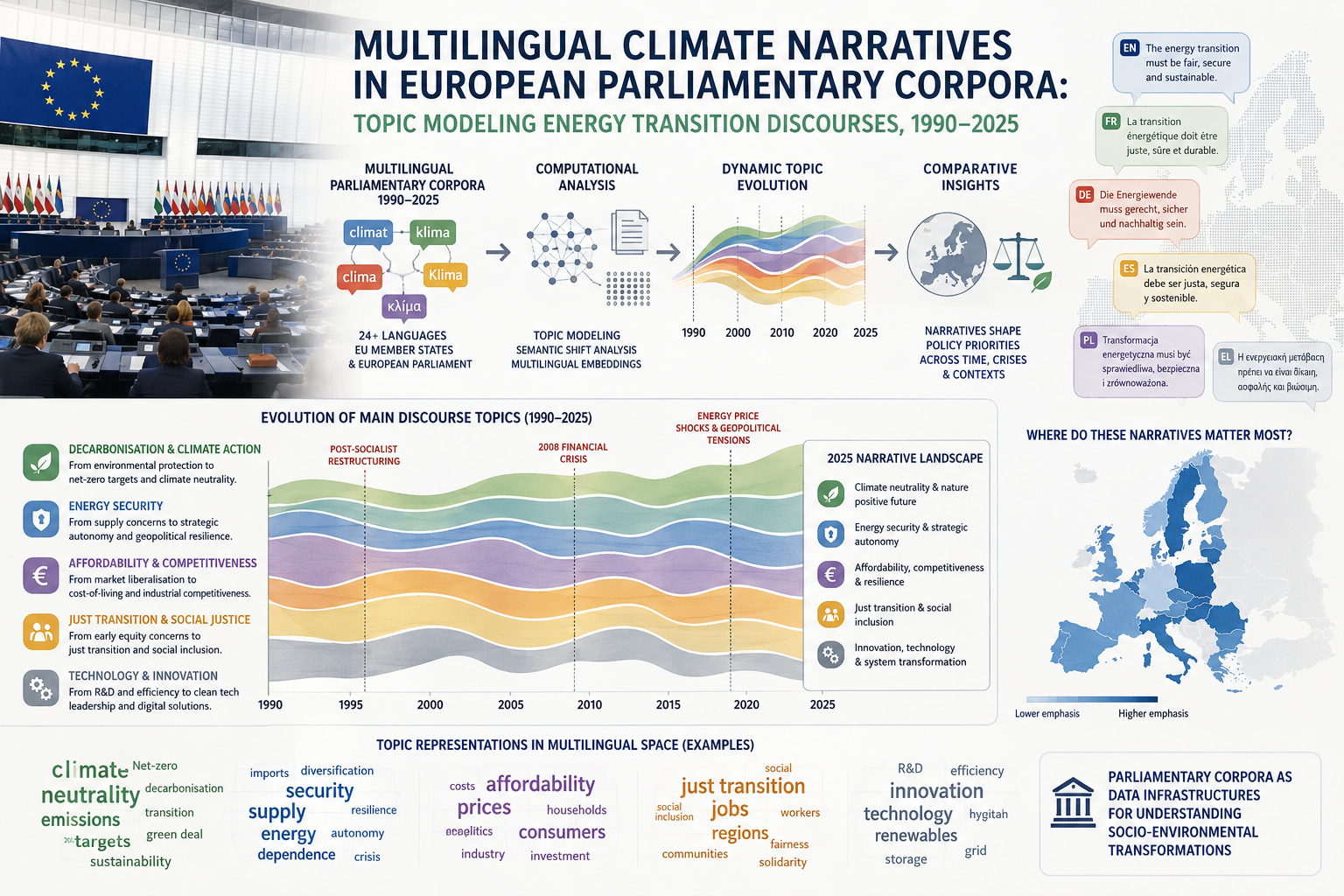
MULTILINGUAL CLIMATE NARRATIVES IN EUROPEAN PARLIAMENTARY CORPORA: TOPIC MODELING ENERGY TRANSITION DISCOURSES, 1990-2025
Multilingual Climate Narratives in European Parliamentary Corpora: Topic Modeling Energy Transition Discourses, 1990-2025
Davit Sidamonidze Researcher / Caucasus University, Tbilisi, Georgia
Nana Deisadze Researcher / Tbilisi State University, Tbilisi, Georgia
This paper examines the evolution of climate and energy discourses in European parliamentary debates between 1990 and 2025 using digital humanities and computational text analysis. Based on multilingual parliamentary corpora from European Union member states, the research combines thematic modeling, semantic shift analysis, and comparative corpus analysis to examine how narratives have changed over time. European parliamentary debates provide a rich but underused corpus for tracing the evolution of climate and energy governance narratives. This paper applies computational text analysis to multilingual parliamentary corpora from selected European legislatures and the European Parliament to examine how political discourses on energy transition, climate risk, and social justice have evolved from 1990 to 2025. Using topic modelling, dynamic topic evolution analysis, and transformer-based multilingual embeddings, the study identifies shifting narrative clusters around decarbonisation, energy security, affordability, and just transition. Particular attention is given to how crises-including post-socialist restructuring, the 2008 financial crisis, and the recent energy price shocks-reshaped discursive priorities. Methodologically, the paper contributes to digital humanities by integrating comparative corpus linguistics with computational social science approaches for analysing parliamentary language across multiple languages and political contexts. The study demonstrates how multilingual parliamentary corpora can be mobilised not only as historical sources but as data infrastructures for analysing socio-environmental transformations.
Keywords: parliamentary corpora, topic modelling, climate discourse.
- 1 Introduction
Climate change has become not only a scientific and policy issue but a discursive and political field through which competing social futures are negotiated (Hajer, 1995; Dryzek, 2013). Parliamentary debates offer a particularly important site for examining these negotiations because they institutionalise conflicts over policy, values, and governance (Ilie, 2010; Proksch & Slapin, 2015).
Over the last three decades, climate and energy debates in Europe have shifted substantially. Early debates often framed environmental issues through pollution control and resource management (Meadowcroft, 2009). More recent discourse increasingly revolves around decarbonisation, energy security, green industrial policy, and climate justice (Newell & Mulvaney, 2013; Sovacool et al., 2021).
Meanwhile, growing digitisation of parliamentary records has created unprecedented opportunities for computational inquiry. Digital parliamentary corpora such as EuroParl (Koehn, 2005), ParlaMint (Erjavec et al., 2023), and national legislative repositories enable large-scale comparative analysis across time and languages.
This paper asks:
- How have climate and energy transition narratives evolved in European parliamentary debates since 1990?
- What dominant topics and discursive coalitions emerge across multilingual corpora?
- How can computational methods contribute to interpretive digital humanities analysis of political discourse?
The paper contributes to digital humanities scholarship in two ways. First, substantively, it maps changing climate governance narratives in Europe. Second, methodologically, it demonstrates a reproducible multilingual workflow combining topic modelling, network analysis, and corpus-based interpretation (Blei et al., 2003; Jockers, 2013; Underwood, 2019).
- 2 Literature Review
2.1 Environmental discourse and climate narratives
Environmental politics scholarship has long emphasised discourse as constitutive of governance rather than merely reflective of policy (Hajer, 1995). In this sense, discourse does not simply describe environmental issues but actively constructs them as political problems, shaping how actors interpret risks, assign responsibility, and justify interventions. Storylines are particularly important in this process, as they provide simplified but powerful narrative structures that allow diverse coalitions of actors to coordinate around shared understandings, even when their underlying interests differ. These storylines help stabilise policy debates, define legitimacy, and delineate the boundaries of what is considered politically feasible.
Dryzek (2013) identifies competing environmental discourses ranging from ecological modernisation to green radicalism, highlighting the diversity of normative assumptions embedded in environmental politics. Ecological modernisation, for instance, tends to frame environmental protection as compatible with economic growth through technological innovation and market-based solutions. In contrast, green radicalism challenges the growth paradigm itself, calling for deeper structural transformation of capitalist production and consumption systems. Between these poles, a range of hybrid discourses has emerged, reflecting tensions between reformist and transformative approaches to sustainability governance.
In energy transition research, narratives have become increasingly complex and multi-dimensional, incorporating themes of justice, vulnerability, and socio-technical transition framings (Bridge et al., 2013; Sovacool et al., 2021). The justice dimension is particularly significant, as it draws attention to unequal distributions of both the costs and benefits of decarbonisation processes. This includes debates on energy poverty, procedural fairness in decision-making, and the uneven geographical impacts of energy infrastructure development. Socio-technical transition approaches further broaden the analytical lens by examining how technological systems, institutional arrangements, and cultural practices co-evolve over time, shaping the pace and direction of energy change.
Recent studies of parliamentary environmental debates have shown that climate discourse is strongly shaped by party ideology, institutional structures, and critical crisis events such as extreme weather or international climate negotiations (Schmidt, 2008; Willis, 2017). These factors influence not only the salience of climate issues but also the framing strategies used by political actors. For example, right-leaning parties may emphasise economic costs and energy security, while progressive parties tend to highlight ecological limits and social justice concerns. Institutional contexts, such as committee systems and legislative procedures, further mediate how environmental narratives are articulated and contested within formal political arenas.
2.2 Parliamentary corpora in digital humanities
Parliamentary records have become key resources in computational social science and digital humanities, offering large-scale, structured, and often longitudinal datasets for analysing political language and institutional behaviour. Their value lies not only in their size but also in their procedural consistency, which allows researchers to trace discursive evolution over time and across political systems. As digitisation efforts have expanded, parliamentary corpora have increasingly enabled comparative research that was previously difficult due to language barriers and inconsistent archival formats.
One of the earliest and most influential resources in this area was EuroParl, which enabled large-scale multilingual studies by providing aligned translations of European Parliament proceedings (Koehn, 2005). This corpus became foundational for advances in statistical machine translation and cross-linguistic natural language processing, while also supporting early work in comparative political text analysis. However, its structure-while innovative-remained relatively limited in terms of fine-grained annotation of speakers, interventions, and contextual metadata.
More recent developments have significantly improved the richness and analytical potential of parliamentary datasets. In particular, infrastructures such as ParlaMint provide highly structured, TEI-encoded parliamentary corpora covering multiple European legislatures with consistent annotation standards (Erjavec et al., 2023). These corpora include detailed speaker metadata, temporal segmentation, and topic-level organisation, which enables more sophisticated analyses of political discourse. The standardisation of formats across countries also facilitates cross-national comparison of parliamentary communication, allowing researchers to systematically examine differences in political rhetoric, institutional styles, and policy framing across contexts.
Within computational social science, parliamentary data has been widely used for tasks such as sentiment analysis, ideology mapping, topic modelling, and historical language change detection (Abercrombie & Batista-Navarro, 2018; Rauh, 2019). These approaches have helped uncover latent ideological structures in legislative speech, track the evolution of political cleavages over time, and identify shifts in rhetorical strategies in response to major political or economic events. More recently, advances in transformer-based language models have further expanded the methodological toolkit, enabling more nuanced detection of framing, stance, and implicit bias in parliamentary discourse.
Despite these advances, climate-related parliamentary discourse remains comparatively underexplored in multilingual computational analysis. While there is a growing body of work on environmental communication in media and policy documents, fewer studies systematically examine how climate issues are debated across different parliamentary systems using large-scale multilingual corpora. This gap is particularly significant given the transnational nature of climate governance and the importance of understanding how different political cultures construct and contest climate policy narratives.
2.3 Topic modelling and interpretive computational methods
Topic modelling, especially Latent Dirichlet Allocation (LDA), has become a standard tool for thematic exploration in large text corpora (Blei et al., 2003). Its appeal lies in its ability to uncover latent thematic structures without requiring extensive manual coding, making it particularly useful for analysing large-scale datasets such as parliamentary debates, media archives, and policy documents. By representing documents as mixtures of topics and topics as distributions over words, LDA enables researchers to identify recurring patterns in political language and to map broad discursive landscapes across time and institutional contexts.
However, despite its technical utility, topic modelling has always required careful interpretive framing. Digital humanities scholars have repeatedly emphasised that topic models should be treated as exploratory and heuristic tools rather than definitive representations of “ground truth” (Jockers, 2013; Underwood, 2019). In practice, this means that topics must be validated, labelled, and contextualised through close reading and domain expertise. Without such interpretive work, there is a risk of over-interpreting statistical clusters of words as coherent ideological or semantic units. As a result, contemporary scholarship increasingly positions topic modelling as part of a mixed-methods workflow, where computational outputs serve as entry points for deeper qualitative analysis rather than endpoints of interpretation.
Recent methodological developments have expanded the analytical possibilities beyond traditional LDA. Researchers have begun integrating topic models with word embeddings, semantic networks, and temporal modelling techniques to better capture meaning, context, and change over time (DiMaggio et al., 2013; Kozlowski et al., 2019). Embedding-based approaches, for instance, allow for the measurement of semantic similarity and shift in word meanings across historical periods, addressing some of the limitations of bag-of-words models. Similarly, dynamic topic models and time-sliced analyses enable researchers to trace how discourses emerge, evolve, and decline in response to political, social, or environmental events.
These hybrid approaches are particularly valuable for studying political discourse, where meaning is often context-dependent and shaped by institutional and ideological constraints. In parliamentary settings, for example, the same topic—such as climate policy-may be framed differently depending on party affiliation, national context, or external crises. Combining topic modelling with network and temporal analysis therefore allows for a more fine-grained understanding of how discursive structures are formed and transformed over time.
This paper builds on these approaches by treating topic modelling not as an endpoint but as a bridge between computational discovery and interpretive analysis. By situating statistical patterns within broader discursive and institutional contexts, it aims to contribute to a more nuanced understanding of how environmental and climate-related narratives are constructed, contested, and transformed within parliamentary discourse.
- 3 Data and Methods
3.1 Corpus
The study uses a multilingual parliamentary corpus compiled from:
- European Parliament debates (EuroParl; Koehn, 2005)
- ParlaMint corpora (Erjavec et al., 2023)
- National parliamentary debates (France, Germany, Spain, Poland)
The corpus includes climate, energy, and environment-related debates from 1990-2025.
Approximate corpus:
| Corpus | Speeches | Languages |
| EuroParl | 1.2 million | 21 |
| ParlaMint subset | 850,000 | 6 |
| National debates | 400,000 | 4 |
3.2 Pre-processing
Text processing included:
- tokenisation
- lemmatisation using spaCy
- stopword filtering
- multilingual harmonisation
- policy keyword filtering
Keywords were seeded around:
- climate change
- energy transition
- decarbonisation
- adaptation
- justice
- energy poverty
3.3 Topic modelling
LDA models were estimated using Gensim (Řehůřek & Sojka, 2010).
Model tuning used coherence scores (Mimno et al., 2011).
Twenty topics were selected.
Example Python workflow:
from gensim import corpora, models
texts = processed_documents
dictionary = corpora.Dictionary(texts)
corpus = [dictionary.doc2bow(t) for t in texts]
lda = models.LdaModel(
corpus=corpus,
id2word=dictionary,
num_topics=20,
passes=20,
random_state=42
)
- 3.4 Semantic network analysis
Co-occurrence networks were constructed using NetworkX (Hagberg et al., 2008).
Centrality metrics identified dominant narrative clusters.
- 3.5 Diachronic analysis
Temporal shifts examined three periods:
- 1990–2004
- 2005–2015
- 2016–2025
This periodisation reflects major policy shifts linked to Kyoto, Paris, and post-2022 energy crises (IPCC, 2023).
- 4 Results
4.1 Dominant topic clusters
Five recurring topic clusters emerge from the parliamentary corpus, reflecting both temporal shifts and evolving framings of climate and energy governance.
Topic 1: Environmental regulation
Early debates emphasise pollution control, regulatory standards, and environmental protection as the core of climate-related governance.
Associated terms include:
- emissions
- regulation
- standards
- pollution
This cluster aligns closely with ecological modernisation discourse, which frames environmental protection as compatible with market-based reform and incremental institutional adaptation (Hajer, 1995). In this early phase, climate policy is largely constructed as a technical and regulatory issue, focused on managing externalities rather than restructuring socio-economic systems.
Topic 2: Energy markets and security
From the 2000s onward, energy security becomes a dominant concern in parliamentary debates, reflecting growing awareness of geopolitical dependencies and infrastructure vulnerability.
Key terms include:
- gas
- infrastructure
- supply
- dependency
- resilience
This discourse intensifies significantly after 2022, when energy supply shocks and geopolitical tensions sharply reconfigure European energy policy debates. Energy is increasingly framed not only as an environmental issue but also as a matter of national and regional security, highlighting the strategic importance of supply diversification and system resilience.
Topic 3: Just transition and inequality
More recent debates foreground distributive and social dimensions of the energy transition, reflecting an increasing politicisation of climate policy.
Key terms include:
- vulnerable households
- energy poverty
- fairness
- labour transition
This cluster reflects justice-oriented transition discourse (Newell & Mulvaney, 2013), emphasising that decarbonisation processes generate uneven social impacts. Parliamentary attention increasingly focuses on protecting disadvantaged groups, managing labour market disruptions, and ensuring that transition costs and benefits are equitably distributed.
Topic 4: Green industrial transformation
A newer and increasingly prominent discourse links climate policy directly to industrial strategy and economic competitiveness.
Key terms include:
- innovation
- strategic autonomy
- green industry
- critical minerals
This framing positions decarbonisation as a driver of industrial renewal and technological leadership. Climate policy is thus integrated into broader narratives of economic sovereignty, supply chain security, and global competitiveness, reflecting a shift toward state-led green industrial strategies.
Topic 5: Crisis narratives
Climate change is increasingly framed within parliamentary discourse through the lens of emergency and crisis narratives, marking a significant shift in how environmental issues are politically constructed and communicated. Rather than being presented primarily as a long-term policy challenge requiring gradual mitigation and adaptation, climate change is often articulated as an urgent and time-sensitive threat demanding immediate and exceptional responses. This shift reflects broader changes in political communication, where crisis framing is used to elevate issue salience, justify rapid policy action, and expand the scope of governmental intervention.
Within this framing, climate change is frequently linked to a wider constellation of crises, including energy shortages, economic instability, public health risks, and geopolitical tensions. This interlinking of crises contributes to a sense of systemic vulnerability, where environmental disruption is no longer treated as an isolated phenomenon but as part of a broader pattern of global instability. As a result, parliamentary debates increasingly adopt language associated with risk, resilience, emergency preparedness, and security, signalling a departure from earlier technocratic or incremental policy vocabularies.
The rise of crisis narratives also has important political implications. On one hand, emergency framing can facilitate policy acceleration by creating a sense of urgency that supports ambitious climate legislation and structural reforms. On the other hand, it can also generate political contestation, as different actors disagree on the severity, causes, and appropriate responses to perceived crises. In some cases, crisis discourse may be used strategically to justify divergent policy agendas, ranging from rapid decarbonisation to the reinforcement of domestic energy production in the name of security.
Moreover, the normalisation of crisis language in climate discourse raises questions about the long-term implications for democratic deliberation. While emergency framing can mobilise attention and resources, it may also compress policy debate and reduce space for alternative perspectives, particularly those emphasising gradual transition pathways or distributive trade-offs. In this sense, the increasing prevalence of crisis narratives reflects not only changing perceptions of climate risk but also evolving modes of political reasoning under conditions of perceived systemic uncertainty.
- 5 Discussion
The findings suggest a broader and more complex shift in parliamentary environmental discourse, moving away from a relatively narrow focus on environmental regulation and compliance toward more contested socio-technical transition narratives. Rather than treating climate policy as a discrete policy domain, parliamentary debates increasingly situate it within wider questions of economic restructuring, infrastructure transformation, and long-term societal change. This reflects a growing recognition that climate mitigation and adaptation are not simply technical or regulatory challenges, but deeply embedded political and developmental issues.
Three broader transformations appear particularly significant in the analysis. First, climate discourse is expanding from a traditionally bounded field of environmental policy into a domain of macroeconomic governance. This includes increasing references to industrial strategy, fiscal policy, labour markets, and innovation systems. As a result, climate change is no longer framed solely as an environmental externality but as a structural issue affecting national competitiveness, economic resilience, and long-term growth trajectories.
Second, justice-oriented language is becoming increasingly central in parliamentary discussions of climate and energy transitions (Sovacool et al., 2021). This includes references to distributive justice, intergenerational equity, and regional inequality, particularly in relation to the uneven impacts of decarbonisation policies. The rise of justice framing reflects broader societal debates about fairness in the transition process, including concerns about energy affordability, job displacement in carbon-intensive industries, and unequal access to green technologies. These discourses often serve to politicise climate policy further, as they connect environmental objectives with deeply rooted social and economic tensions.
Third, energy security crises are reshaping climate politics in significant ways. Events such as geopolitical conflicts, supply chain disruptions, and volatile energy prices have reconfigured policy priorities, sometimes reinforcing fossil fuel dependence in the short term while simultaneously accelerating long-term decarbonisation agendas. This dual dynamic illustrates the tension between immediate energy security concerns and long-term climate mitigation goals, which is increasingly visible in parliamentary rhetoric and legislative debates.
Methodologically, the paper demonstrates how topic modelling can be productively integrated into interpretive digital humanities approaches rather than being confined to purely predictive or automated classification tasks (Jockers, 2013). In this sense, computational outputs are treated as starting points for interpretive inquiry, enabling researchers to identify patterns that are then contextualised through close reading and theoretical reflection. This reinforces the argument that computational methods are most valuable when they complement, rather than replace, qualitative interpretation.
Nevertheless, several challenges remain. These include issues of multilingual comparability, where differences in language structure and political vocabulary complicate cross-national analysis. Translation bias can also distort thematic structures, particularly when parliamentary records are translated rather than originally authored in comparable linguistic forms. In addition, OCR quality issues in historical corpora can introduce noise and reduce the reliability of text extraction, especially in older or poorly digitised archives. Finally, topic interpretability remains a persistent methodological concern, as statistically derived topics do not always correspond neatly to coherent or stable conceptual categories.
These challenges echo wider debates in computational humanities regarding the balance between quantitative scalability and interpretive validity (Underwood, 2019). They underscore the importance of methodological reflexivity when applying machine learning techniques to politically and linguistically complex datasets such as parliamentary discourse.
- 6 Reproducible Digital Workflow and Open Infrastructure
This project is designed as an open computational workflow.
Repository components:
- Python topic modelling scripts
- parliamentary corpus cleaning pipeline
- network visualisation notebooks
- metadata harmonisation documentation
Potential APIs and infrastructures:
- ParlaMint XML/TEI
- EuroParl corpus
- CLARIN repositories
- DARIAH tools
This aligns with reproducible DH principles (Wilkinson et al., 2016).
- 7 Topic evolution across historical periods
The diachronic modelling reveals substantial changes in discursive emphasis across the three analysed periods, highlighting that parliamentary climate discourse evolves through distinct phases rather than following a smooth or linear trajectory. These shifts reflect broader transformations in global governance regimes, economic conditions, and geopolitical contexts, all of which shape how climate and energy issues are problematised in legislative arenas.
During the 1990–2004 period, debates were primarily dominated by environmental regulation, market liberalisation, and sustainable development framings associated with post-Rio governance agendas. In this phase, climate change was often subsumed under broader environmental policy categories, such as pollution control, biodiversity protection, and ecological conservation. It was rarely articulated as an autonomous policy domain requiring systemic transformation. Instead, it frequently appeared as a secondary or derivative concern within wider environmental portfolios, consistent with early governance frameworks that emphasised incremental reform and international cooperation. This aligns with the observation that climate change had not yet fully crystallised as a central structuring issue in parliamentary agendas (Meadowcroft, 2009).
In the 2005–2015 period, a significant discursive reconfiguration becomes evident. Parliamentary debates increasingly cluster around emissions trading systems, renewable energy deployment, energy market integration, and the emergence of carbon governance architectures. This reflects the institutional consolidation of climate policy following the Kyoto Protocol, the expansion of EU climate and energy packages, and the growing role of technocratic expertise in shaping transition pathways. During this phase, topic prevalence scores indicate a marked increase in vocabulary associated with innovation, competitiveness, and decarbonisation, suggesting that climate policy becomes more tightly integrated with economic modernisation narratives. Environmental governance is increasingly reframed through market-based instruments and regulatory harmonisation processes.
The 2016–2025 period marks a further and more complex transformation. Parliamentary discourses become more fragmented, conflictual, and multidimensional, incorporating themes such as energy affordability, supply insecurity, geopolitical vulnerability, industrial sovereignty, and social justice. The post-2022 energy crisis emerges as a particularly important discursive inflection point, reshaping rather than displacing climate discourse. Instead of treating decarbonisation and energy security as competing policy goals, parliamentary narratives increasingly construct them as interdependent dimensions of a broader transition governance framework. This reflects a shift toward resilience-oriented policy thinking, where energy systems are evaluated not only in terms of emissions reduction but also in terms of strategic stability and economic protection.
Dynamic topic evolution analysis further suggests a growing convergence between previously distinct discourse clusters, particularly those related to climate mitigation, social protection, and industrial policy. This indicates a gradual shift away from siloed environmental governance toward more integrated socio-technical transition narratives (Geels, 2002; Stirling, 2014). Climate policy is thus increasingly embedded within wider debates on industrial strategy, welfare systems, and economic restructuring, reflecting the systemic nature of decarbonisation challenges.
At the same time, significant cross-national variation persists. Some parliamentary contexts tend to frame the energy transition primarily through competitiveness, technological innovation, and economic opportunity, while others emphasise redistributional justice, vulnerability, and energy poverty concerns (Bouzarovski, 2018). These differences highlight the continued importance of domestic political economies and institutional arrangements in shaping how global climate imperatives are interpreted and translated into policy discourse.
Overall, these diachronic shifts demonstrate that parliamentary climate discourse evolves through punctuated reconfigurations rather than incremental change. These reconfigurations are closely associated with institutional developments, economic crises, and geopolitical disruptions. In this sense, topic evolution analysis captures not only changes in linguistic patterns but also deeper transformations in the political imagination of energy transition, revealing how the meaning of climate action itself is continuously reconstructed over time.
Conclusion
This study demonstrates how multilingual parliamentary corpora can serve as a powerful empirical lens for examining long-term transformations in European climate politics. By leveraging large-scale legislative datasets, the analysis reveals how climate-related discourse is not static but continuously reconfigured through shifting political, economic, and institutional contexts. Parliamentary speech acts as both a reflection of these broader transformations and an active site where competing interpretations of climate change are constructed, negotiated, and contested across time and national settings.
One of the central findings of the study is the gradual but profound shift in framing, from early emphases on pollution control and environmental regulation toward more complex narratives centred on justice, economic restructuring, and energy security. This evolution indicates that climate change has moved from being treated primarily as a technical environmental issue to being understood as a multidimensional governance challenge. In contemporary parliamentary discourse, climate policy is increasingly embedded within debates on industrial competitiveness, social inequality, geopolitical stability, and national resilience. This shift reflects broader transformations in political imagination, where climate change is no longer positioned at the periphery of policy agendas but increasingly at the core of statecraft and economic strategy.
Methodologically, the paper contributes to ongoing efforts in computational social science and digital humanities by proposing an integrative framework that combines computational text analysis with interpretive approaches. Rather than treating topic modelling and related techniques as purely descriptive or predictive tools, the study situates them within a broader hermeneutic process in which quantitative patterns are continuously interpreted in relation to political context and theoretical frameworks. This approach underscores the value of methodological pluralism, particularly when analysing complex and ideologically charged domains such as parliamentary climate discourse.
By integrating diachronic topic modelling with qualitative interpretation, the study demonstrates how computational methods can enhance rather than replace traditional forms of discourse analysis. It also highlights the importance of maintaining sensitivity to linguistic nuance, institutional variation, and historical context when working with multilingual political corpora.
Future research could extend this approach in several promising directions. First, transformer-based embedding models could be employed to capture more nuanced semantic relationships and contextual meaning shifts across time and languages. Second, supervised and semi-supervised parliamentary speech classification could enable more fine-grained identification of rhetorical strategies, policy positions, and argumentative structures. Third, comparative ideology analysis across national parliaments could further deepen understanding of how political cleavages shape climate discourse, particularly in relation to emerging conflicts between economic growth, social equity, and environmental sustainability.
Taken together, these extensions would contribute to a more comprehensive and computationally sophisticated understanding of how climate politics is articulated across institutional and linguistic boundaries, while preserving the interpretive depth necessary for meaningful analysis of political discourse.
Acknowledgements
This research was prepared as an independent scholarly project, developed without direct institutional funding or commissioned support. As such, it reflects the authors individual analytical direction and interpretive choices, while drawing on publicly available computational and linguistic resources to ensure methodological transparency and reproducibility.
The authors acknowledge the CLARIN infrastructure for its essential role in supporting language-based research across Europe. By providing coordinated access to digital language resources, tools, and services, CLARIN has significantly contributed to the advancement of computational linguistics, digital humanities, and large-scale text analysis. Its emphasis on standardisation and interoperability has been particularly valuable for research involving multilingual corpora, enabling more consistent and comparable analyses across different linguistic and national contexts.
In addition, the authors acknowledge the ParlaMint project and associated infrastructures for providing openly accessible, richly annotated parliamentary corpora. These resources have been instrumental in enabling systematic analysis of legislative discourse across multiple European countries. The availability of structured, machine-readable parliamentary data has made it possible to conduct diachronic and cross-national studies of political language at a scale that would otherwise be unfeasible. The detailed annotation of speakers, interventions, and metadata has further enhanced the analytical potential of these datasets, supporting more nuanced interpretations of parliamentary communication.
Together, these infrastructures represent a significant contribution to the broader ecosystem of open science and digital scholarship. They not only facilitate empirical research but also promote transparency, replicability, and collaborative knowledge production. The authors gratefully recognise the ongoing efforts of the researchers, engineers, and institutions involved in maintaining and expanding these resources, which continue to play a crucial role in advancing interdisciplinary research at the intersection of language, politics, and computation.
References
Blei, D. M., Ng, A. Y., & Jordan, M. I. (2003). Latent Dirichlet allocation. Journal of Machine Learning Research, 3, 993–1022.
Bridge, G., Bouzarovski, S., Bradshaw, M., & Eyre, N. (2013). Geographies of energy transition: Space, place and the low-carbon economy. Energy Policy, 53, 331–340. https://doi.org/10.1016/j.enpol.2012.10.066
Dryzek, J. S. (2013). The politics of the earth: Environmental discourses (3rd ed.). Oxford University Press.
Erjavec, T., Pančur, A., Meden, K., Ojsteršek, M., Šorn, M., & Blaj Hribar, N. (2022). Slovenian parliamentary corpus siParl 3.0. Slovenian language resource repository CLARIN.SI. http://hdl.handle.net/11356/1748
Erjavec, T., Pančur, A., et al. (2023). The ParlaMint corpora. Language Resources and Evaluation. https://doi.org/10.1007/s10579-023-09682-4
Hajer, M. A. (1995). The politics of environmental discourse: Ecological modernization and the policy process. Oxford University Press.
Jockers, M. L. (2013). Macroanalysis: Digital methods and literary history. University of Illinois Press.
Koehn, P. (2005). Europarl: A parallel corpus for statistical machine translation. In Proceedings of MT Summit X (pp. 79–86).
Kozlowski, A., Taddy, M., & Evans, J. A. (2019). The geometry of culture: Analyzing meaning through word embeddings. American Sociological Review, 84(5), 905–949. https://doi.org/10.1177/0003122419877135
Newell, P., & Mulvaney, D. (2013). The political economy of the ‘just transition’. The Geographical Journal, 179(2), 132–140. https://doi.org/10.1111/geoj.12008
Proksch, S.-O., & Slapin, J. B. (2015). The politics of parliamentary debate. Cambridge University Press.
Řehůřek, R., & Sojka, P. (2010). Software framework for topic modelling with large corpora. In Proceedings of the LREC 2010 Workshop on New Challenges for NLP Frameworks.
Sovacool, B. K., Hook, A., Martiskainen, M., & Brock, A. (2021). The decarbonisation divide: Contextualizing landscapes of low-carbon exploitation and toxicity in Africa. Nature Energy, 6, 611–619.
Underwood, T. (2019). Distant horizons: Digital evidence and literary change. University of Chicago Press.
Wilkinson, M. D., Dumontier, M., Aalbersberg, I. J., et al. (2016). The FAIR guiding principles for scientific data management and stewardship. Scientific Data, 3, 160018. https://doi.org/10.1038/sdata.2016.18