

Weekly Recap – Aug 2 – 9 / 2026
Georgia
Item 01
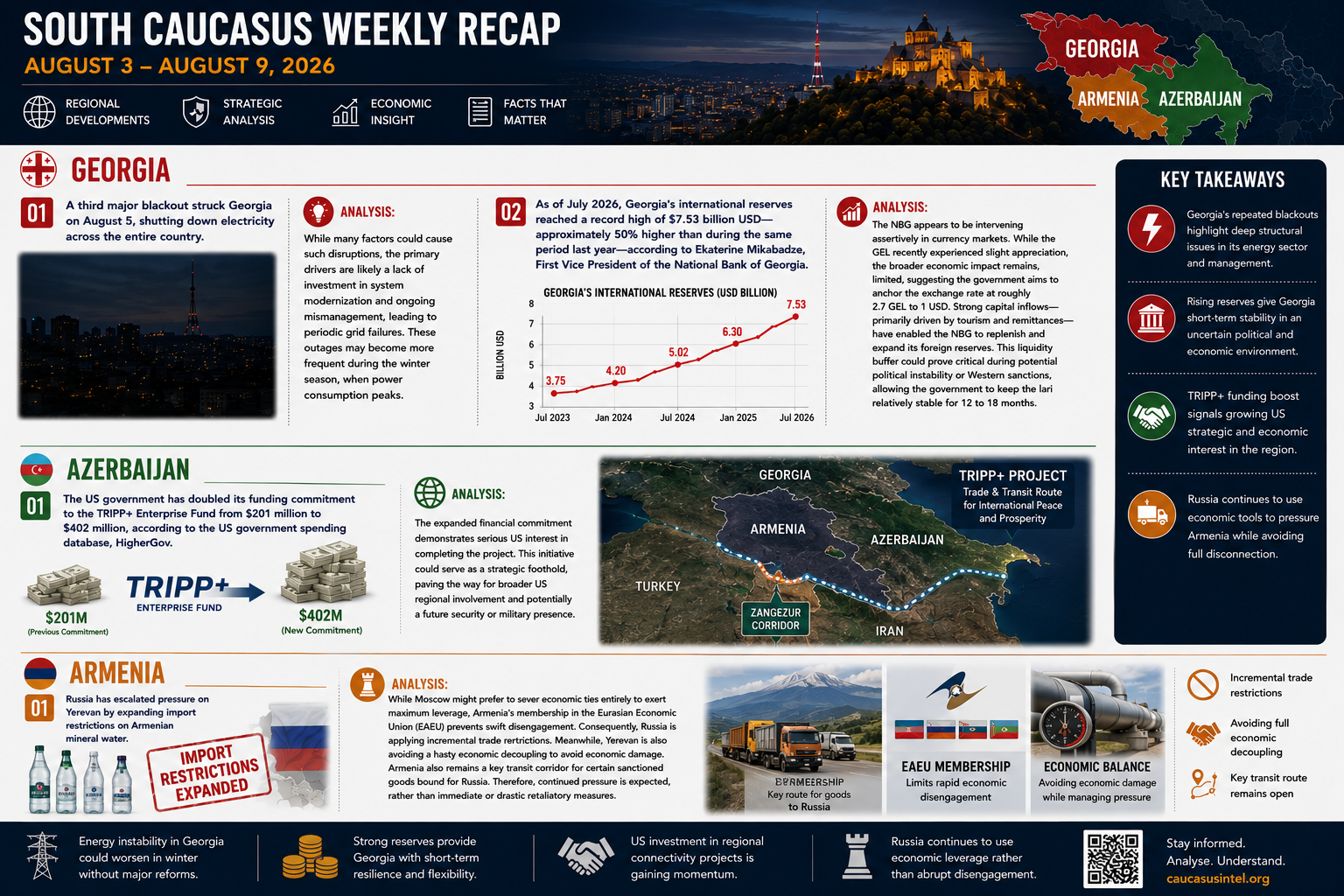
A third major blackout struck Georgia on August 5, shutting down electricity across the entire country.
Analysis
While many factors could cause such disruptions, the primary drivers are likely a lack of investment in system modernization and ongoing mismanagement, leading to periodic grid failures. These outages may become more frequent during the winter season, when power consumption peaks.
Item 02
As of July 2026, Georgia’s international reserves reached a record high of $7.53 billion USD — approximately 50% higher than during the same period last year — according to Ekaterine Mikabadze, First Vice President of the National Bank of Georgia.
Analysis
The National Bank of Georgia (NBG) appears to be intervening assertively in currency markets. While the Georgian Lari (GEL) recently experienced slight appreciation, the broader economic impact remains limited, suggesting the government aims to anchor the exchange rate at roughly 2.7 GEL to 1 USD. Strong capital inflows — primarily driven by tourism and remittances — have enabled the NBG to replenish and expand its foreign reserves. This liquidity buffer could prove critical during potential political instability or Western sanctions, allowing the government to keep the lari relatively stable for 12 to 18 months.
Azerbaijan
Item 01
The US government has doubled its funding commitment to the TRIPP+ Enterprise Fund from $201 million to $402 million, according to the US government spending database, HigherGov.
Analysis
The expanded financial commitment demonstrates serious US interest in completing the project. This initiative could serve as a strategic foothold, paving the way for broader US regional involvement and potentially a future security or military presence.
Armenia
Item 01
Russia has escalated pressure on Yerevan by expanding import restrictions on Armenian mineral water.
Analysis
While Moscow might prefer to sever economic ties entirely to exert maximum leverage, Armenia’s membership in the Eurasian Economic Union (EAEU) prevents swift disengagement. Consequently, Russia is applying incremental trade restrictions. Meanwhile, Yerevan is also avoiding a hasty economic decoupling to avoid economic damage. Armenia also remains a key transit corridor for certain sanctioned goods bound for Russia. Therefore, continued pressure is expected, rather than immediate or drastic retaliatory measures.