

Salaries in the South Caucasus
Open full screen map in new tab
The salary data for Georgia, Armenia and Azerbaijan reveal a strongly uneven regional labor market. Monthly salaries vary substantially not only between countries, but also between individual regions and districts within the same country. The contrast is particularly strong between major economic centers and peripheral or predominantly rural areas.
Regional picture
Across the 89 individual locations in the three countries, the median monthly salary is approximately $398.35.
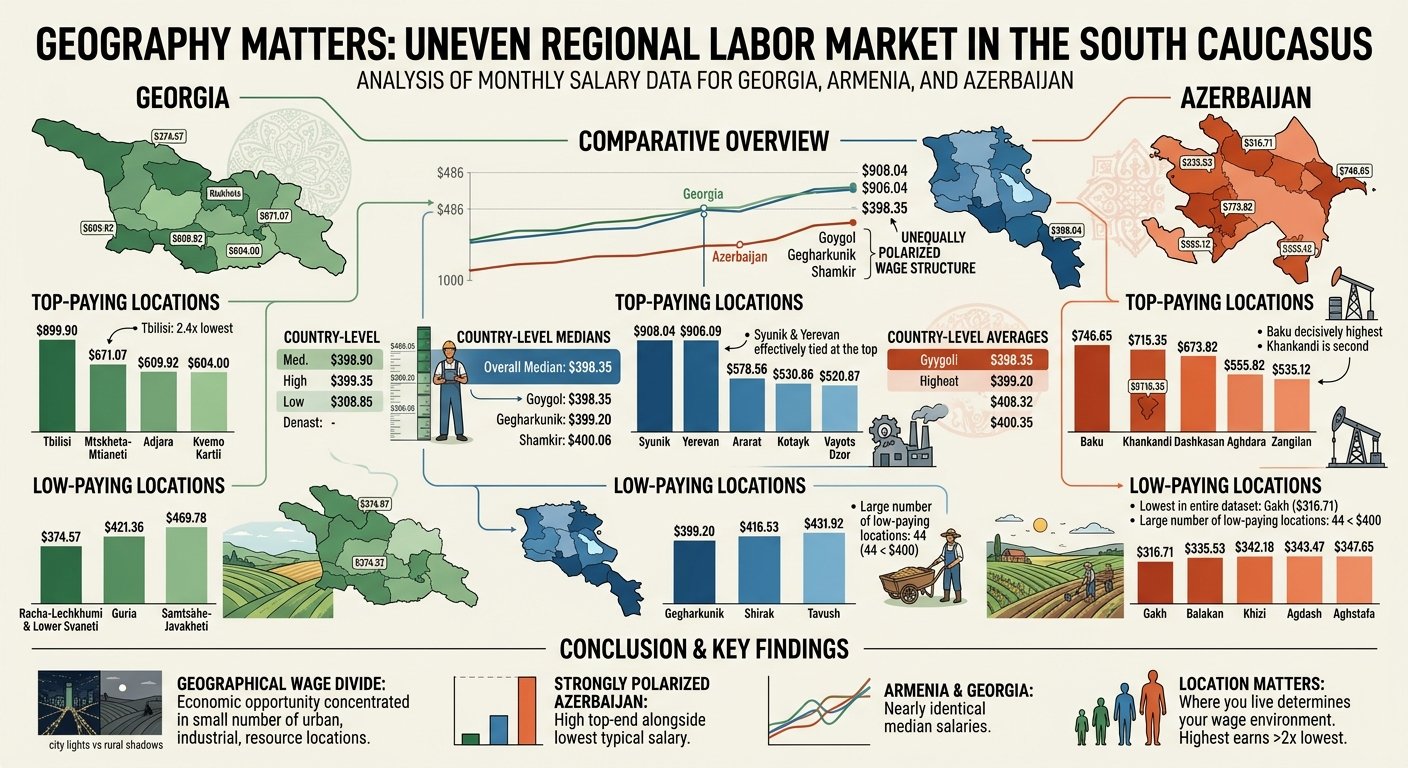
The highest salary in the entire dataset is recorded in Syunik, Armenia, at $908.04 per month. The lowest is in Gakh district, Azerbaijan, at $316.71. The difference between these two locations is therefore almost $591 per month, with the highest salary being nearly three times the lowest.
The data show that the South Caucasus does not have a uniform wage structure. Instead, relatively high-income economic centers coexist with large numbers of lower-paid regions.
| Country | Highest location | Salary | Lowest location | Salary | Median salary |
|---|---|---|---|---|---|
| Georgia | Tbilisi | $899.90 | Racha-Lechkhumi & Lower Svaneti | $374.57 | $485.80 |
| Armenia | Syunik | $908.04 | Gegharkunik | $399.20 | $487.86 |
| Azerbaijan | Baku | $746.65 | Gakh | $316.71 | $382.59 |
| All locations | Syunik | $908.04 | Gakh | $316.71 | $398.35 |
The overall median corresponds almost exactly to Goygol district in Azerbaijan, where the reported salary is $398.35. The next locations around the regional midpoint are Gegharkunik in Armenia at $399.20 and Shamkir in Azerbaijan at $400.06.
Georgia
Georgia has a pronounced concentration of high salaries in and around the country’s main economic centers.
Tbilisi is by far the highest-paid location, with a monthly salary of $899.90. This is almost 2.4 times the lowest regional salary, recorded in Racha-Lechkhumi and Lower Svaneti at $374.57.
The Georgian median is $485.80, represented by Imereti.
After Tbilisi, the highest salaries are found in:
- Mtskheta-Mtianeti: $671.07
- Adjara: $609.92
- Kvemo Kartli: $604.00
At the lower end are:
- Racha-Lechkhumi and Lower Svaneti: $374.57
- Guria: $421.36
- Samtskhe-Javakheti: $469.78
The Georgian figures suggest a strong relationship between wages and economic concentration. Tbilisi’s position is particularly striking: its salary is more than $200 above even the second-highest Georgian region.
Only one Georgian location in the dataset has a salary below $400, while four locations exceed $600. This makes Georgia’s wage distribution relatively concentrated toward the middle and upper part of the regional comparison.
Armenia
Armenia has the highest median among the three countries, at $487.86 per month, with Armavir representing the median location.
The country’s highest salary is found in Syunik, at $908.04, narrowly exceeding Yerevan at $906.09. This is one of the most interesting results in the entire dataset.
Syunik therefore stands out as the highest-paid location in the entire South Caucasus sample. Its salary is only about $2 higher than Yerevan’s, meaning that Armenia’s two leading locations are effectively tied at the top.
The other high-income Armenian regions are:
- Ararat: $578.56
- Kotayk: $530.86
- Vayots Dzor: $520.87
At the bottom of the Armenian distribution are:
- Gegharkunik: $399.20
- Shirak: $416.53
- Tavush: $431.92
The gap between Syunik and Gegharkunik is approximately $509 per month.
Armenia therefore combines an unusually high top end with a relatively strong median. Five of the eleven locations have salaries above $500, while only Gegharkunik falls below $400.
The exceptionally high Syunik figure likely reflects the region’s particular economic structure, including its industrial and mining activity. It should therefore not be interpreted simply as evidence that all southern Armenian regions have salaries comparable to Yerevan.
Azerbaijan
Azerbaijan has the lowest median salary of the three countries, at $382.59 per month, represented by Aghsu district.
The highest-paid location is Baku, at $746.65, correcting the earlier version of this analysis. Khankandi, at $715.35, is second, followed by Dashkasan, at $673.82.
The leading Azerbaijani locations are therefore:
- Baku: $746.65
- Khankandi: $715.35
- Dashkasan: $673.82
- Aghdara: $555.82
- Zangilan: $535.12
At the bottom of the distribution are:
- Gakh: $316.71
- Balakan: $335.53
- Khizi: $342.18
- Agdash: $343.47
- Aghstafa: $347.65
The contrast between Baku and Gakh is substantial. Baku’s salary is about $430 higher per month, and roughly 95% above Azerbaijan’s median.
Azerbaijan also has a much larger number of low-paying locations than either Georgia or Armenia. 44 of the 67 individual locations are below $400, while only eight exceed $500. This gives Azerbaijan a lower typical salary despite the presence of several exceptionally high-paying locations.
This is an important feature of the Azerbaijani data: the country has strong high-income pockets but a relatively low median. Baku is clearly dominant, but several non-capital areas also produce salaries substantially above the national regional median.
Comparing the three countries
The most striking result is that Georgia and Armenia have almost identical median salaries:
- Georgia: $485.80
- Armenia: $487.86
The difference is only about $2 per month.
Azerbaijan is substantially lower:
- Azerbaijan: $382.59
This means the Azerbaijani median is roughly $103–105 below the Georgian and Armenian medians, or about 21% lower.
However, the highest salary in Azerbaijan is still considerably higher than its median. Baku’s $746.65 demonstrates that the country has significant high-income economic centers even though most locations in the dataset fall below $400.
The country-level averages tell a somewhat different story because they are more heavily influenced by the highest-paid locations. The average salaries in the dataset are approximately:
| Country | Average salary |
| Georgia | $543.07 |
| Armenia | $552.12 |
| Azerbaijan | $410.70 |
The difference between the median and average is particularly revealing. In all three countries, the average is higher than the median because a relatively small number of high-paying locations pull the average upward. This effect is strongest in Azerbaijan.
Geography matters almost as much as country
The data suggest that national comparisons alone can be misleading.
A worker’s location within a country can have a major impact on the salary environment. The highest-to-lowest salary ratio is approximately:
- Georgia: 2.40×
- Armenia: 2.27×
- Azerbaijan: 2.36×
In other words, the best-paid location in each country earns more than twice the salary of the lowest-paid location.
This is not simply a capital-city phenomenon.
Georgia and Armenia show strong capital or major-center effects. Tbilisi is clearly dominant in Georgia, while Yerevan is almost exactly tied with Syunik in Armenia.
Azerbaijan is more unusual. Baku is the country’s highest-paid location, but Khankandi, Dashkasan, Aghdara and Zangilan also appear among the highest-paying locations. The country’s wage geography therefore appears to reflect a mixture of capital-city concentration, industrial activity and resource-intensive economic areas.
The most important findings
The dataset points to several broader conclusions.
First, Georgia and Armenia have very similar typical regional salaries. Their medians are almost identical despite the different structures of their economies.
Second, Azerbaijan has the lowest typical salary in the comparison, but not the lowest top-end salaries. Its wage structure is more polarized, with many locations below $400 alongside several very high-paying areas.
Third, Syunik is the highest-paid location in the entire dataset. At $908.04, it narrowly exceeds Yerevan and Tbilisi. This is particularly notable because Syunik is not a national capital.
Fourth, Baku is decisively the highest-paid location in Azerbaijan, at $746.65. Khankandi is second at $715.35, rather than first.
Fifth, the overall median of approximately $398 is much lower than the salaries observed in the leading economic centers. A person living in one of the highest-paid areas can therefore experience a wage environment radically different from someone living in a lower-income district elsewhere in the same country.
Finally, the South Caucasus has a clear geographical wage divide. Economic opportunity and salary levels are concentrated in a relatively small number of locations, while a much larger number of peripheral areas remain clustered around the $320–420 range.
Conclusion
The salary map of the South Caucasus is characterized by strong internal inequality rather than a simple hierarchy between countries.
Armenia and Georgia have almost identical median regional salaries of around $486–488, while Azerbaijan’s median is considerably lower at $382.59. Yet the highest-paid locations reach almost $900, demonstrating how strongly individual economic centers can distort the picture presented by national averages.
The most striking contrast is therefore not simply between Georgia, Armenia and Azerbaijan. It is between places within those countries.
Tbilisi, Yerevan, Syunik and Baku operate in a very different wage environment from many peripheral regions. Meanwhile, locations such as Gakh, Racha-Lechkhumi and Lower Svaneti, and Gegharkunik remain close to or below $400 per month.
Taken together, the data suggest that where a person lives is a major determinant of the salary environment they face in the South Caucasus. The region’s labor market is geographically fragmented, with economic activity and higher wages concentrated in a relatively small number of urban, industrial and resource-intensive locations.