

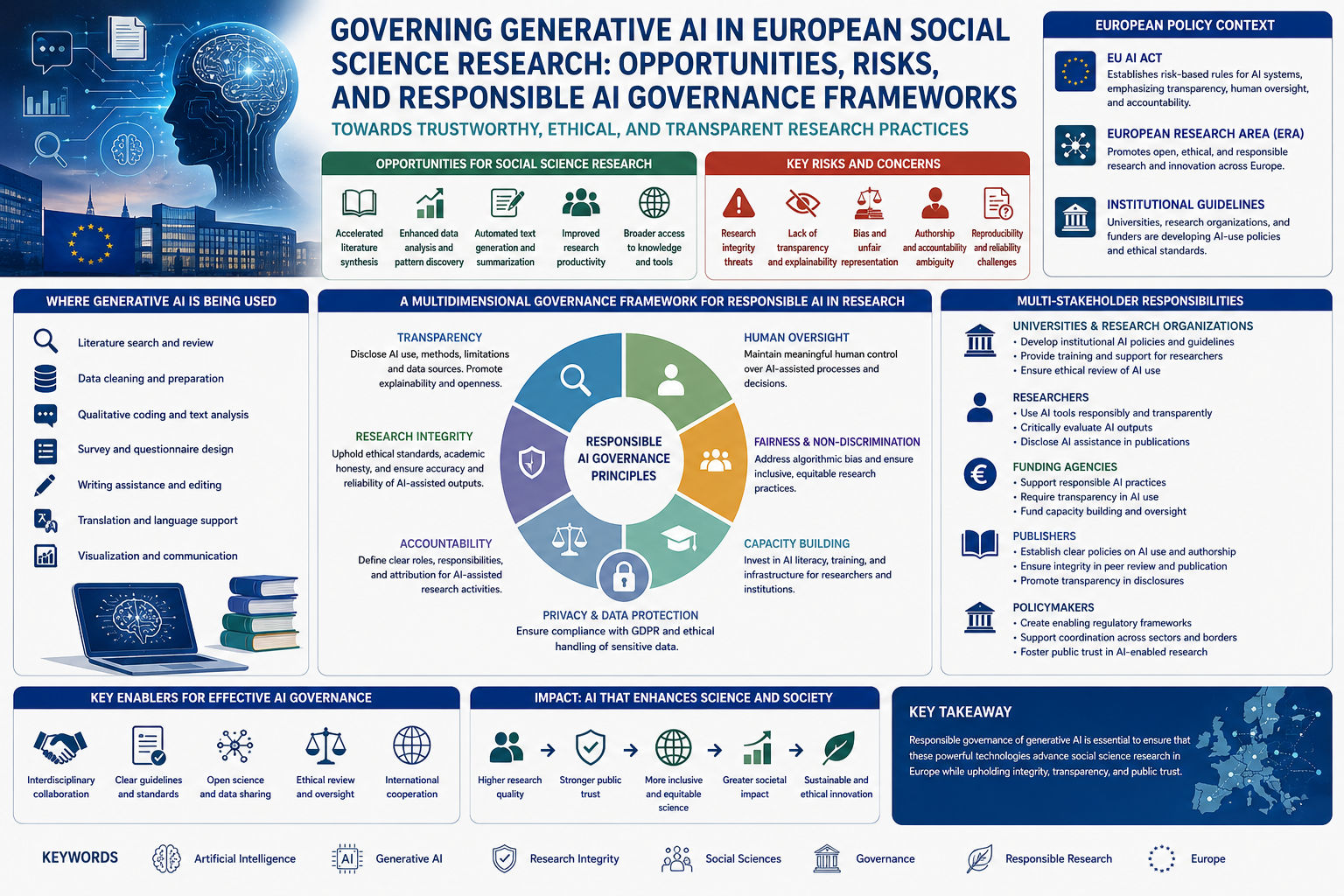
AI Governance and Research Integrity in European Social Sciences: Toward Responsible Use of Generative Artificial Intelligence
AI Governance and Research Integrity in European Social Sciences: Toward Responsible Use of Generative Artificial Intelligence
Davit Sidamonidze
Independent Researcher / University of Warsaw
ORCID: 0000-0002-0386-896X
Nana Deisadze
Independent Researcher / Tbilisi State University
ORCID: 0000-0003-0561-1719
Abstract
The rapid emergence of generative artificial intelligence (GenAI) has begun to transform research practices across the social sciences. Large language models, automated text generation systems, and AI-assisted analytical tools offer substantial opportunities for increasing research productivity, enhancing literature synthesis, improving data analysis, and supporting scientific communication. Simultaneously, these technologies raise significant concerns regarding research integrity, transparency, reproducibility, authorship, bias, and academic accountability. This paper examines the governance challenges associated with the growing use of generative AI within European social science research. Drawing upon recent European policy initiatives, including the European Union Artificial Intelligence Act, the European Research Area framework, and emerging institutional guidelines, the study analyzes how responsible AI governance can support trustworthy and ethical research practices. The paper proposes a multidimensional governance framework emphasizing transparency, human oversight, research integrity, and institutional capacity building. The findings suggest that effective AI governance requires coordinated action among universities, research organizations, funding agencies, publishers, and policymakers to ensure that AI technologies enhance rather than undermine scientific quality and public trust.
Keywords: artificial intelligence, research integrity, social sciences, governance, generative AI, Europe, responsible research
- Introduction
Generative artificial intelligence has emerged as one of the most significant technological developments affecting scientific research in recent years. Large language models such as ChatGPT, Claude, Gemini, and similar systems have rapidly entered academic environments, influencing how researchers search for information, draft texts, analyze data, and communicate findings.
The social sciences occupy a particularly sensitive position within this transformation. Unlike many natural sciences, social science research frequently depends upon interpretation, contextual understanding, qualitative reasoning, and theoretical reflection. Consequently, the integration of AI technologies into social scientific inquiry raises important questions concerning authorship, epistemology, transparency, and scientific integrity.
European research institutions have increasingly recognized both the opportunities and risks associated with AI adoption. The European Commission’s emphasis on trustworthy artificial intelligence, open science, and responsible innovation provides an important policy context for addressing these challenges (European Commission, 2020).
This paper addresses three research questions:
- How is generative AI currently influencing social science research?
- What governance challenges arise from AI adoption in social sciences?
- Which governance principles can support responsible AI use in European research?
The paper contributes to emerging debates on AI governance by focusing specifically on social scientific research practices and European institutional contexts.
- Literature Review
2.1 Artificial intelligence in academic research
Artificial intelligence applications in research have expanded considerably during the past decade. Early applications focused on machine learning, data mining, and automated classification systems (Jordan & Mitchell, 2015). More recently, generative AI systems have introduced capabilities involving text generation, summarization, translation, and conversational interaction.
Several studies have demonstrated the potential of AI to support literature reviews, coding qualitative data, identifying research trends, and generating hypotheses (Dwivedi et al., 2023). AI-assisted tools may increase research efficiency and reduce administrative burdens.
However, concerns have emerged regarding hallucinated information, fabricated references, embedded biases, and reduced transparency (Bender et al., 2021).
2.2 Research integrity and responsible science
Research integrity represents a fundamental principle of scientific practice. The European Code of Conduct for Research Integrity emphasizes honesty, reliability, respect, and accountability (ALLEA, 2023).
The introduction of AI systems challenges traditional understandings of:
- authorship,
- originality,
- accountability,
- transparency,
- reproducibility.
Several publishers and research organizations have established preliminary guidelines restricting AI authorship while allowing limited use under disclosure requirements.
2.3 AI governance in Europe
European AI governance is strongly influenced by the concept of trustworthy artificial intelligence. The European Commission (2019) identified seven key requirements:
- human agency,
- technical robustness,
- privacy,
- transparency,
- diversity,
- societal well-being,
- accountability.
The recently adopted EU AI Act further establishes risk-based regulatory approaches for AI applications.
Research institutions increasingly seek to translate these principles into practical governance mechanisms.
- Methodology
This paper employs a qualitative policy analysis approach.
The analysis draws upon:
- European Union policy documents,
- AI governance frameworks,
- research integrity guidelines,
- university policies,
- scholarly literature.
Documents examined include:
- EU AI Act,
- European Research Area policies,
- ALLEA research integrity code,
- UNESCO AI recommendations,
- OECD AI principles.
A thematic analysis identified recurring governance dimensions relevant to social science research.
- AI Applications in Social Science Research
Generative AI currently influences multiple stages of the research process.
4.1 Literature review and synthesis
Researchers increasingly use AI tools to:
- summarize articles,
- identify research themes,
- compare literature,
- generate bibliographies.
These applications can reduce time requirements but also risk introducing inaccuracies.
4.2 Data analysis
AI supports:
- qualitative coding,
- thematic analysis,
- text mining,
- sentiment analysis,
- survey processing.
Computational social science increasingly integrates machine learning techniques into research workflows.
4.3 Scientific writing
AI systems assist with:
- grammar correction,
- language editing,
- summarization,
- drafting sections,
- translation.
While these functions may improve accessibility, they raise concerns regarding originality and intellectual contribution.
4.4 Teaching and supervision
Universities increasingly encounter AI-generated assignments, AI-assisted theses, and AI-supported student research.
This creates new responsibilities for educators and supervisors.
- Governance Challenges
5.1 Transparency
Researchers often fail to disclose AI use.
Undisclosed use may undermine trust in scientific outputs.
Transparent reporting standards are therefore necessary.
5.2 Bias and fairness
AI systems may reproduce biases embedded within training data.
Social science research addressing sensitive topics such as:
- migration,
- gender,
- ethnicity,
- inequality,
may be particularly vulnerable.
5.3 Accountability
If AI-generated information proves inaccurate, responsibility remains unclear.
Current consensus suggests that researchers retain full responsibility for all outputs.
5.4 Reproducibility
Generative AI outputs may vary over time.
Identical prompts can produce different responses.
This complicates scientific replication.
5.5 Authorship
Most publishers currently reject AI authorship.
Human researchers remain responsible for:
- interpretation,
- analysis,
- conclusions,
- ethical decisions.
- Toward a European Governance Framework
A responsible AI governance framework for social sciences should include four dimensions.
6.1 Transparency
Researchers should disclose:
- tools used,
- functions employed,
- stages of use.
AI statements may become standard components of publications.
6.2 Human oversight
Researchers must maintain intellectual responsibility.
AI should support rather than replace scientific reasoning.
6.3 Institutional capacity building
Universities should provide:
- AI literacy training,
- ethical guidelines,
- practical workshops,
- institutional support.
Early-career researchers particularly require assistance.
6.4 Open science integration
AI governance should align with:
- open science,
- reproducibility,
- research integrity.
Documentation of AI use improves transparency.
- Discussion
The adoption of generative AI presents both opportunities and risks.
AI can:
- increase productivity,
- support multilingual communication,
- democratize access to knowledge,
- reduce administrative burdens.
However, poorly governed AI use may:
- weaken scientific integrity,
- increase misinformation,
- reduce transparency,
- undermine public trust.
European research institutions possess unique advantages because they already emphasize:
- responsible research,
- ethics,
- open science,
- research integrity.
The challenge therefore involves operationalizing these principles within everyday research practices.
Networks such as COST Actions, European university alliances, and research infrastructures may play important roles in developing common standards.
- Conclusion
Generative artificial intelligence is rapidly transforming social science research.
The technology offers substantial opportunities for improving research productivity, accessibility, and innovation. However, these benefits can only be realized through responsible governance frameworks that emphasize transparency, accountability, human oversight, and research integrity.
European institutions are particularly well positioned to develop such frameworks due to existing commitments to trustworthy AI and responsible research.
Future research should investigate:
- disciplinary differences in AI adoption,
- institutional governance models,
- researcher attitudes,
- impacts on research quality.
Responsible AI governance will become an essential component of the future European research ecosystem.
References
ALLEA. (2023). The European code of conduct for research integrity (Revised ed.). ALLEA.
Bender, E. M., Gebru, T., McMillan-Major, A., & Shmitchell, S. (2021). On the dangers of stochastic parrots: Can language models be too big? Proceedings of FAccT 2021, 610–623.
Dwivedi, Y. K., Kshetri, N., Hughes, L., et al. (2023). So what if ChatGPT wrote it? Multidisciplinary perspectives on opportunities, challenges and implications of generative conversational AI. International Journal of Information Management, 71, 102642.
European Commission. (2019). Ethics guidelines for trustworthy AI. European Commission.
European Commission. (2020). A European strategy for data. European Commission.
Jordan, M. I., & Mitchell, T. M. (2015). Machine learning: Trends, perspectives, and prospects. Science, 349(6245), 255–260.
OECD. (2019). OECD principles on artificial intelligence. OECD Publishing.
UNESCO. (2021). Recommendation on the ethics of artificial intelligence. UNESCO.
European Union. (2024). Artificial Intelligence Act. Official Journal of the European Union.